
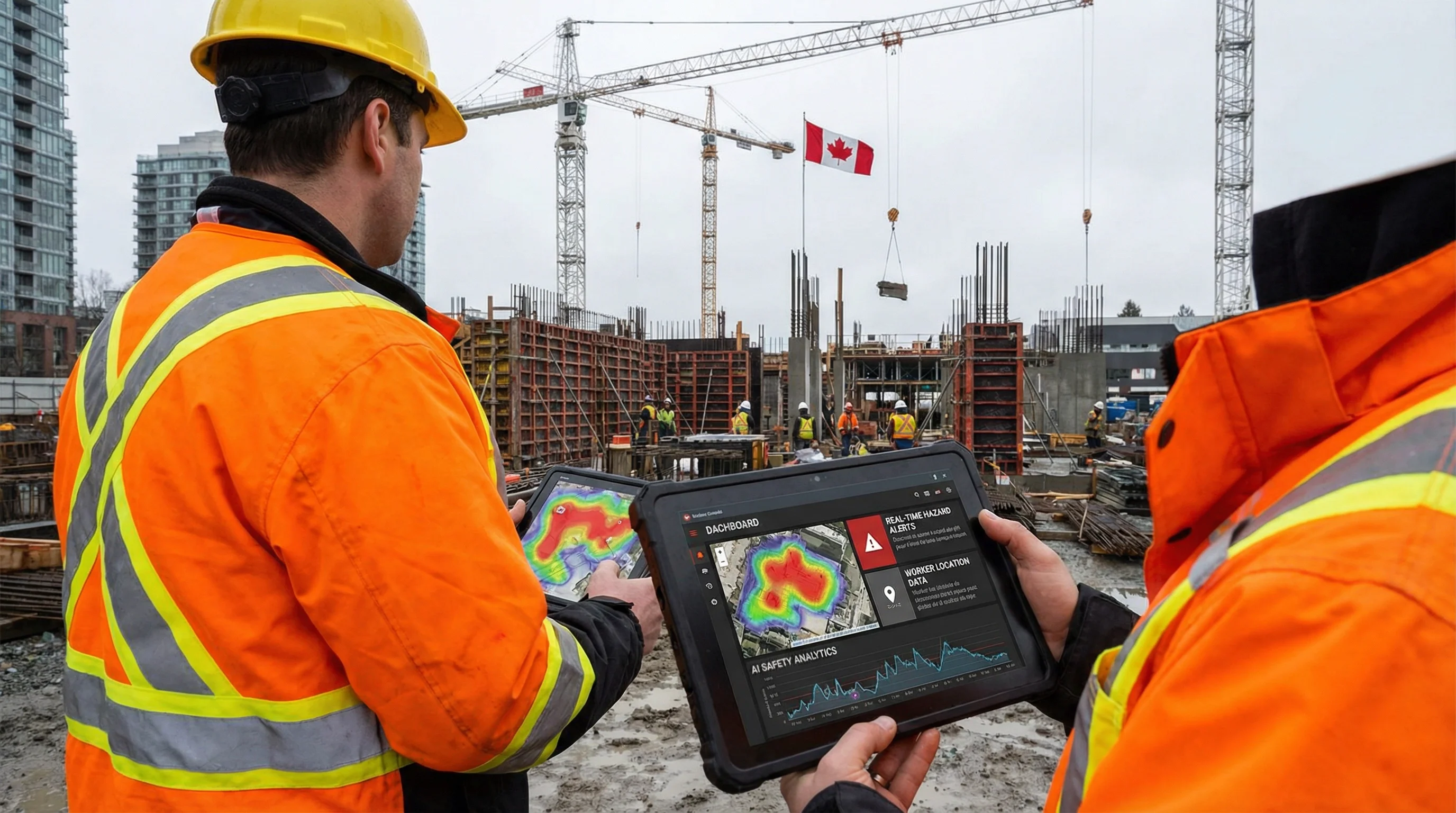
If you follow construction industry news, you have probably read at least a dozen articles in the past two years claiming that artificial intelligence is about to transform safety on job sites. Some of those articles are right. Some are describing technology that is still years away from being practical for the average Canadian general contractor. The gap between the two is worth understanding before you spend money or change how your site operates.
This post is about what AI is actually doing for construction safety in Canada right now, based on real data from Canadian research and real programs running on Canadian sites. It is also honest about what AI cannot do, because that part tends to get left out.
Where Canadian adoption actually stands
The most useful piece of data on this topic comes from an Institute for Work and Health study published in October 2025. Researchers surveyed 810 occupational health and safety professionals in British Columbia and Ontario and asked whether their organizations used AI for health and safety purposes.
Only about a quarter said yes.
That number surprised the lead researcher, Dr. Arif Jetha, who noted that "AI use for OHS was not as common as I anticipated among this sample." Half of respondents said their organizations did not use AI for OHS at all, and the remainder did not know.
The organizations most likely to be using AI for safety were large ones, with 500 or more employees, which were 2.5 times more likely to use AI for OHS than smaller organizations. Highly hazardous workplaces were three times more likely to use it. Ontario organizations were 1.7 times more likely than BC organizations to report AI use for OHS.
For the majority of Canadian construction employers, particularly the smaller contractors that make up most of the industry, AI for safety is still something they are reading about rather than using. That is not a criticism. It is just where things are. The technology is moving fast, but adoption is not uniform, and the hype is well ahead of the practice.
The 4 AI applications that are working right now
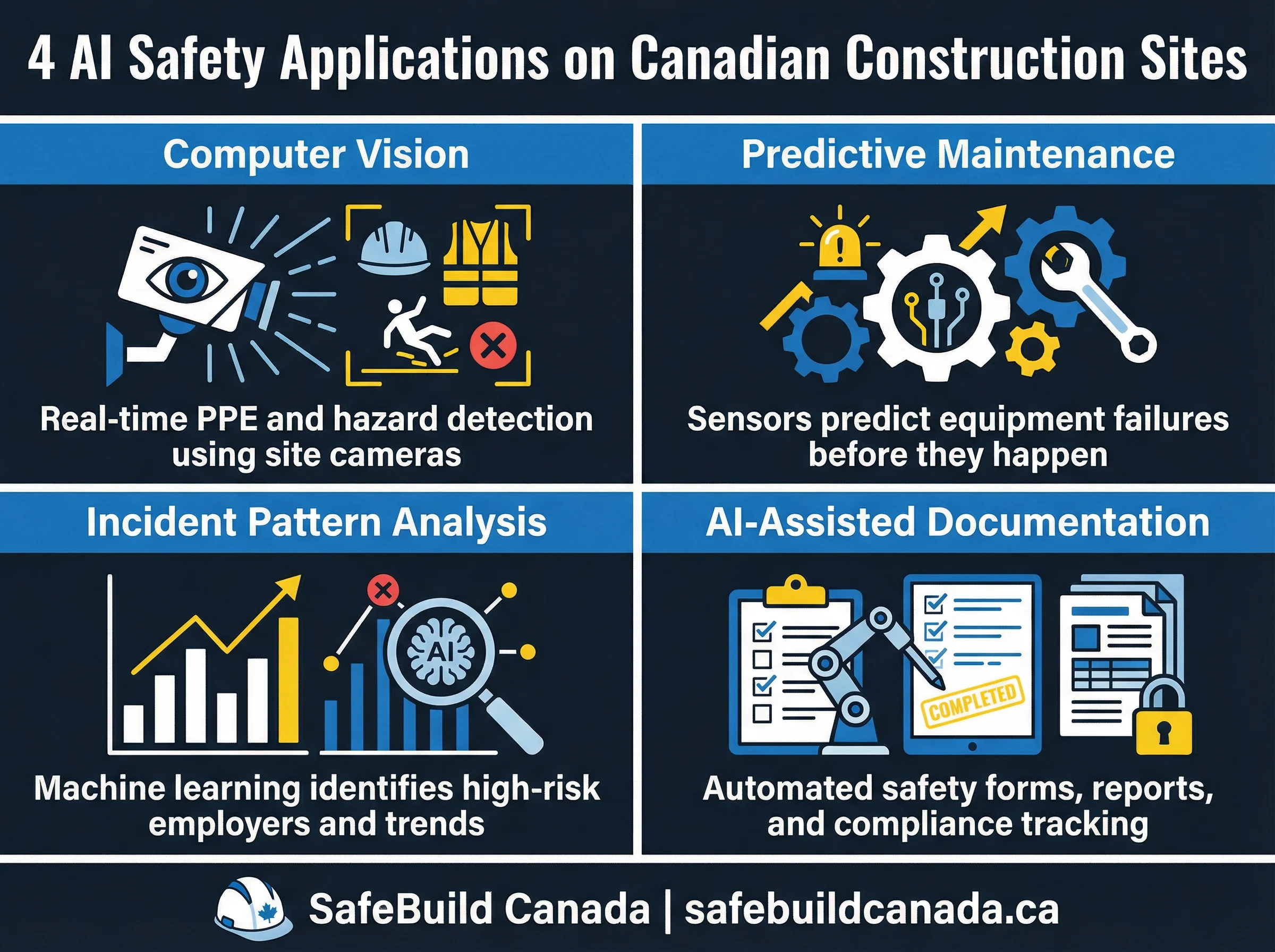
For the organizations that are using AI for safety, the IWH study found four main application areas. These match what Canadian safety professionals and industry observers have described in practice.
Computer vision for PPE and hazard detection. This is the most visible AI safety application on construction sites. Cameras connected to AI systems scan footage in real time and flag when workers are missing hard hats, high-vis vests, or other required PPE. The same systems can detect workers entering exclusion zones, identify blocked emergency exits, and flag unsafe lifting postures. The IWH study found that 22 percent of organizations using AI for OHS were using it to monitor safety behaviors through cameras and sensors. PCL Construction, one of Canada's largest general contractors, noted in its 2025 construction outlook that AI systems using machine learning and computer vision are already monitoring real-time site activities to identify hazards and PPE non-compliance.
Predictive maintenance for equipment. Sensors attached to heavy equipment collect data on vibration, temperature, hydraulic pressure, and engine performance. AI analyzes that stream of data and flags when a machine is showing patterns that historically precede a breakdown. This matters for safety because equipment failures are a real cause of serious incidents on construction sites. PCL reported that predictive maintenance through AI has reduced unplanned downtime and extended equipment life on its projects. The safety benefit is straightforward: a machine that gets serviced before it fails is less likely to fail in a way that injures someone.
Incident pattern analysis. This is where AI is doing something genuinely new for the industry. Rather than waiting for incidents to happen and then investigating them, machine learning systems can analyze large datasets of historical incident reports, near-miss records, and claims data to identify patterns that humans would not easily spot. The BC Construction Safety Alliance partnered with EHS Analytics, a Calgary-based data solutions firm, in the summer of 2023 to build exactly this kind of system. WorkSafeBC provides the BCCSA with an aggregate database covering every construction employer in BC, including injury rates and claim durations. EHS Analytics synthesizes that data into a dashboard that identifies employers who may need support before their injury rates worsen. "Once an employer is identified, we can drill down further to see exactly what type of assistance would be most beneficial," said Erin Linde, director of health and safety services at the BCCSA. The system has allowed the BCCSA to direct targeted outreach to the employers who need it most, rather than spreading resources evenly across all members.
AI-assisted safety documentation. This is the application that most Canadian safety officers are likely to encounter first, because it requires no hardware investment and no cameras on site. AI tools can help draft hazard assessments, generate site-specific safety plans, review existing documentation for gaps, and auto-populate inspection forms. Christl Aggus, CEO of the Canadian Society of Safety Engineering, told the Daily Commercial News in January 2024 that her organization was using AI "cautiously" for forms and policy documents. The caution is appropriate: AI-generated documentation needs to be reviewed by a qualified person before it is used, because the tool does not know your specific site conditions.
A real Canadian case study: BCCSA and EHS Analytics
The BCCSA dashboard is worth spending a moment on, because it is one of the clearest examples of AI being used for construction safety in Canada with real, measurable outcomes.
The problem the BCCSA was trying to solve is a familiar one. They had access to a large database of employer safety data, but the raw data was hard to act on. A small employer with one injury over five years might look fine statistically, or that one injury might be a warning sign. Without a way to contextualize the data, it was difficult to know which employers needed help and what kind of help they needed.
EHS Analytics built a machine learning model that synthesizes the WorkSafeBC data with additional information from the BCCSA's own programs, including Safety Climate Tool survey results. The model identifies employers who appear to be at elevated risk and flags the most appropriate type of intervention, whether that is a visit from a regional safety adviser, help with COR certification, or something else.
The BCCSA's executive director, Mike McKenna, was clear that the system is not a surveillance tool. "We're not a regulator," he said. "We're here to help. If we have a source of data that can help to improve worker safety outcomes and decrease injury costs, it's our duty to share it with our members." All insights from the data remain confidential and are only used to offer free support to employers who want it.
This is a good model for thinking about what AI can do at the industry level: not replacing safety professionals, but helping them direct their attention more effectively.
What AI cannot replace
This is the part that tends to get glossed over in the more enthusiastic coverage of AI in construction safety. The IWH study was direct about it: the effectiveness of AI programs to improve health and safety is not yet clear. The researchers found that AI use was more common among organizations that already had positive perceptions of the technology, which raises the question of whether the results reflect genuine safety improvements or selection bias.
David Dunham, a regional safety adviser at the BCCSA, put it plainly when speaking to the Daily Commercial News: "AI is good for providing useful context. Don't put blind faith in it."
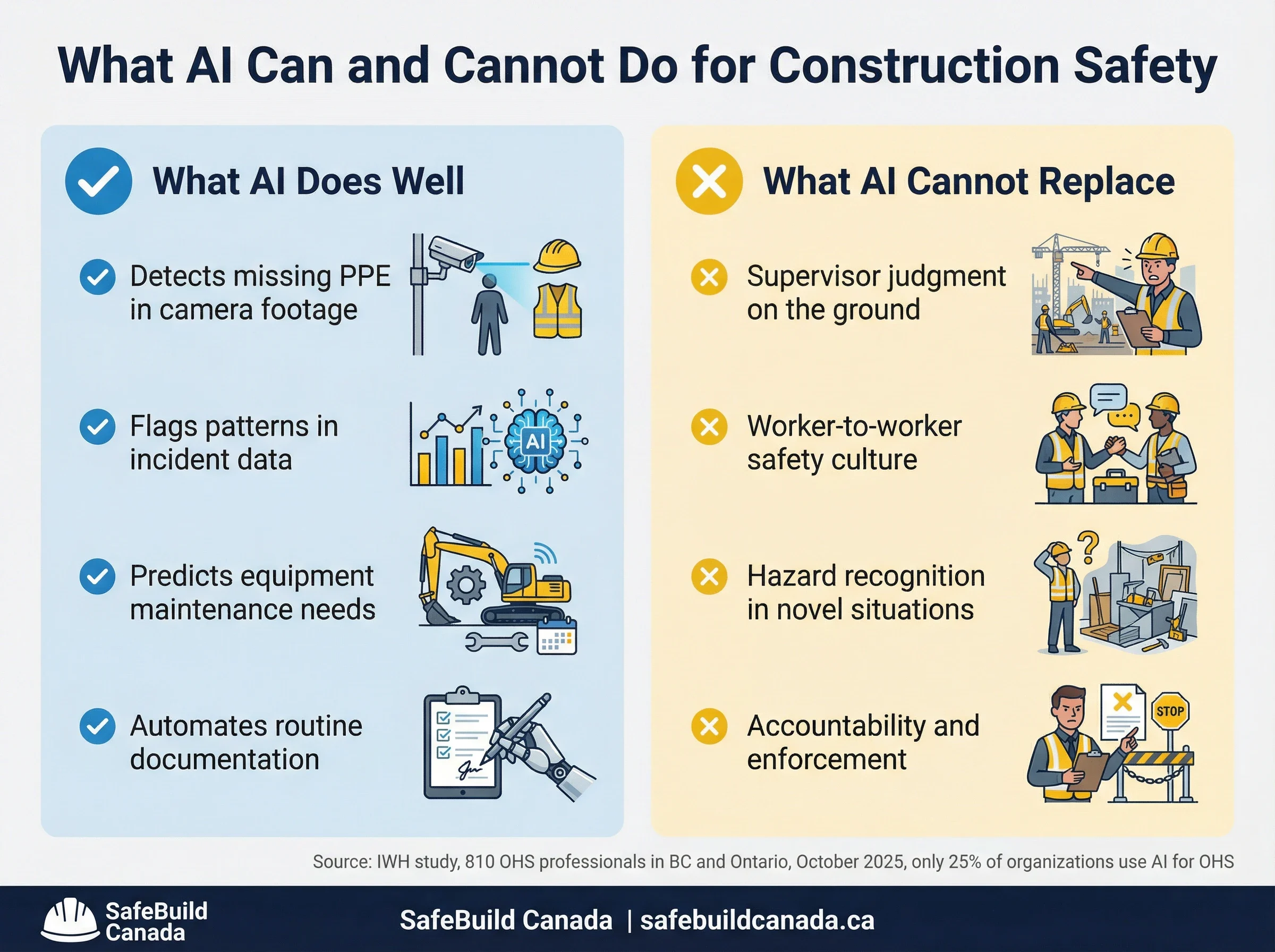
There are four things AI cannot replace on a construction site, and it is worth being specific about them.
The first is supervisor judgment on the ground. A camera can flag that a worker is not wearing a hard hat. It cannot tell you whether that worker just removed it for thirty seconds to wipe sweat from their forehead, or whether they have been working without it for two hours. It cannot read the body language of a crew that is fatigued and cutting corners. It cannot have the conversation that changes someone's behavior. That is still a human job.
The second is worker-to-worker safety culture. The research on what actually prevents serious incidents consistently points to culture: whether workers feel comfortable raising concerns, whether supervisors respond to those concerns, whether safety is treated as a genuine priority rather than a compliance exercise. AI can monitor compliance. It cannot build culture.
The third is hazard recognition in novel situations. AI systems are trained on historical data. They are good at recognizing hazards that look like hazards they have seen before. A genuinely new situation, a new material, an unusual site configuration, an unexpected interaction between two trades, is exactly the kind of thing that AI is likely to miss. Human hazard recognition, particularly from experienced workers who have seen a lot of sites, is still the most reliable tool for novel situations.
The fourth is accountability and enforcement. When something goes wrong on a Canadian construction site, the question of who is responsible is a legal and human one. AI can document what happened. It cannot be held accountable, and it cannot replace the chain of human responsibility that OHS law in Canada is built around.
The legal and privacy considerations
Canadian employers considering AI for safety also need to think through the legal context. On-Site Magazine noted in March 2025 that Canada does not yet have a dedicated legal framework for AI use in the workplace. The relevant laws are a patchwork: the Personal Information Protection and Electronic Documents Act (PIPEDA) and provincial privacy legislation govern how worker data can be collected and used, employment law governs monitoring of workers, and OHS law governs the safety obligations themselves.
If you are deploying cameras with AI to monitor workers, you need to be clear about what data is being collected, how long it is retained, who has access to it, and whether workers have been informed. In most Canadian jurisdictions, monitoring workers without their knowledge is not legally straightforward. Getting this right before deployment is much easier than dealing with a grievance or a privacy complaint after the fact.
Where to start if you want to explore AI for safety
The most practical starting point for most Canadian construction employers is not cameras or sensors. It is documentation.
AI-assisted tools for drafting hazard assessments, reviewing safety plans, and generating site-specific procedures are available now, require no hardware, and can save meaningful time for safety officers who are already stretched. If you are managing digital construction site inspections, some of the platforms already have AI features built in for flagging incomplete records or identifying recurring inspection findings.
For employers who want to go further, the BCCSA's experience with EHS Analytics shows what is possible at the industry level when good data is combined with machine learning. If you are a BCCSA member in BC, that dashboard is already working on your behalf. If you are in another province, it is worth asking your provincial construction safety association whether they have a similar program in development.
For site-level AI, the honest advice is to start with a specific problem rather than a general interest in "AI." If your heavy equipment safety program has a gap in pre-use inspection compliance, a camera-based system that flags missed inspections might be worth investigating. If your safety documentation is the bottleneck, an AI writing tool might be the right place to start. Buying a platform because it has AI features is not a safety strategy.
The IWH's Dr. Jetha put it well: "As AI becomes more affordable and widespread, new OHS tools will likely be developed. We need to look into the utility and effectiveness of AI for OHS problems across different types of organizations." That research is ongoing. In the meantime, the best approach is to match the tool to the problem, not the other way around.
If you are building or reviewing your construction site safety plan, AI can help with the documentation side of that work today. The judgment, the culture, and the accountability still have to come from you.
Sources
Institute for Work and Health, "Differences in firm-level AI use for health and safety," October 2025
Journal of Commerce / BC Construction Safety Alliance, "Industry Special: Mining actionable safety insights from big data," January 6, 2025
Daily Commercial News, "Can Artificial Intelligence make construction safety smarter?", January 23, 2024
PCL Construction, "Construction Outlook 2025: How the AI Revolution Will Influence What We Build and How We Build It," December 2024
On-Site Magazine, "Leveraging AI in construction," March 21, 2025
CCOHS, "OSH Answers Fact Sheets: Health and Safety Programs"