
There is a version of this story that plays out on Canadian construction sites every year. A subcontractor worker gets hurt. The general contractor's first instinct is to say that the subcontractor is responsible for their own workers. Then the Ministry of Labour inspector shows up, and it becomes clear very quickly that the law does not see it that way.
Understanding who is legally responsible for subcontractor safety is not just a compliance exercise. It is the foundation of every decision you make about how you hire subs, how you orient their workers, and how you run your site. Get it wrong, and you are exposed to orders, fines, and in serious cases, charges under the provincial OHS Act.
This guide covers the legal framework in Ontario, BC, and Alberta, and then gets into what a practical subcontractor safety management program actually looks like in the field.
The legal framework: constructor and prime contractor
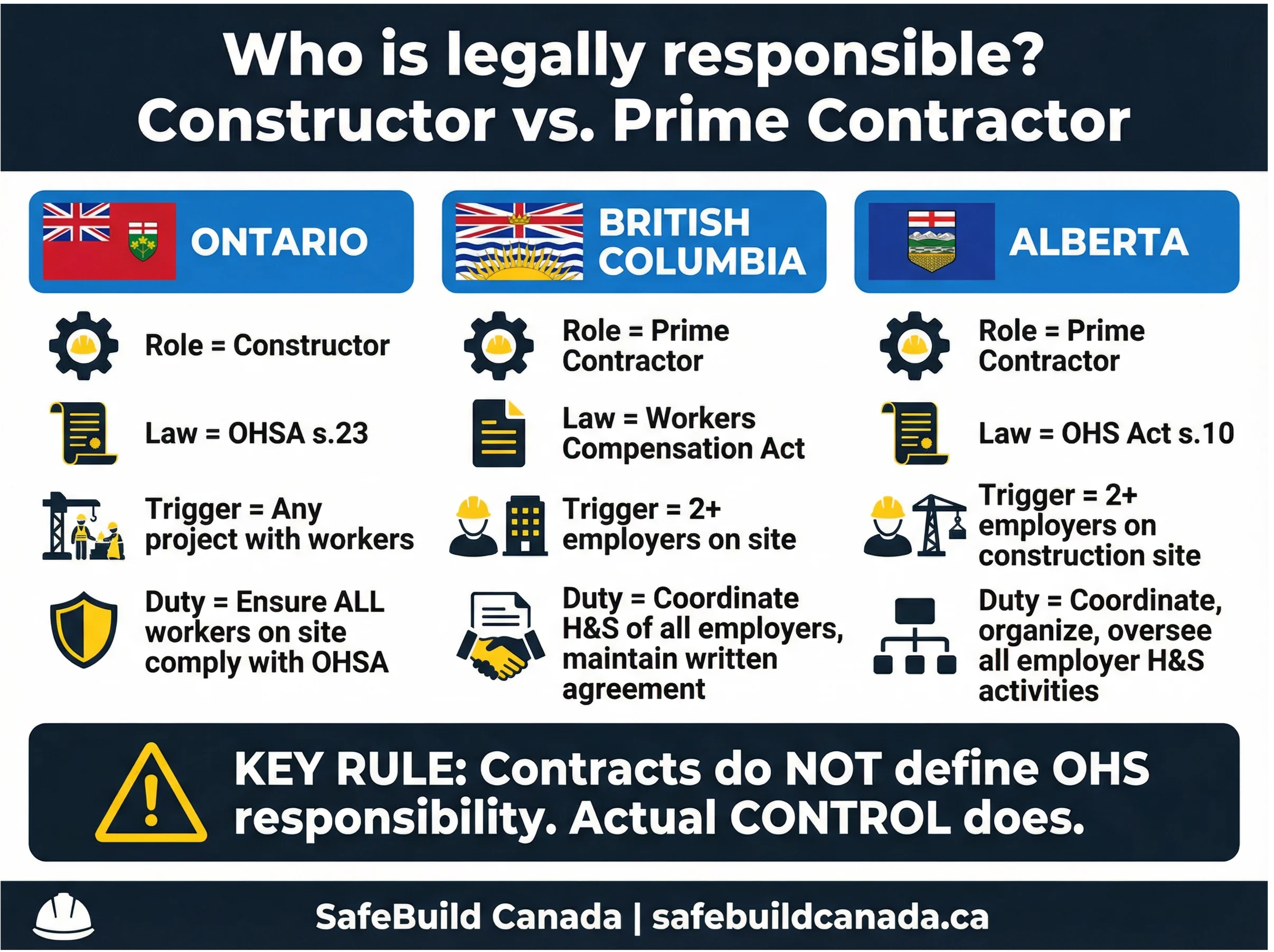
The terminology is different across provinces, but the underlying principle is the same. When multiple employers are working on the same site, one party has overall responsibility for coordinating health and safety. That party is the constructor in Ontario and the prime contractor in BC and Alberta.
In Ontario, the Occupational Health and Safety Act (OHSA) s.23 defines the constructor as the party with overall authority for the project. The constructor must ensure that every employer and worker on the project complies with the OHSA and its regulations. This is not limited to the constructor's own employees. It covers everyone on the site. The Ontario Ministry of Labour's constructor guideline is explicit: even if a general contractor subcontracts all of the actual construction work, the GC remains the constructor and retains overall OHS responsibility.
In BC, the Workers Compensation Act requires a prime contractor on any multi-employer workplace. According to WorkSafeBC's prime contractor information sheet (updated July 2025), the prime contractor must put in place and maintain a system to ensure all employers comply with their health and safety responsibilities. There is one important procedural requirement that catches people off guard: the prime contractor designation must be in writing. Without a written, signed agreement, the owner of the property automatically becomes the prime contractor by default.
In Alberta, the OHS Act s.10 requires a prime contractor on any construction work site with two or more employers. The prime contractor must coordinate, organize, and oversee the health and safety activities of all employers on the site. The Alberta government updated its prime contractor bulletin in June 2024, and the language around coordination duties is clear: the prime contractor is not just responsible for their own workers.
The mistake most GCs make
The most common misunderstanding in subcontractor safety management is the belief that a contract can transfer OHS responsibility. It cannot.
The Canadian Centre for Occupational Health and Safety (CCOHS) analysis of multi-employer construction worksites puts it plainly: contracts do not define OHS responsibility. Actual control does. When an inspector or a court looks at what happened after an incident, they ask three questions. Who knew about the hazard? Who had control over the conditions? Who could have acted to fix it? If the answer to any of those questions points to the GC, the GC is exposed, regardless of what the subcontract says.
This does not mean subcontractors have no responsibility. They do. Each employer on site retains their own OHS obligations to their own workers. The system is one of dual responsibility: the constructor or prime contractor carries overall coordination responsibility, and each individual employer carries responsibility for their own workers and their own work. What the law does not allow is for the GC to hand off all responsibility by signing a subcontract and walking away.
The Workplace Safety and Prevention Services (WSPS) makes this point well in their guidance on OHS duties for contract workers. When work is performed on your site, the employer who hired for those contracted services carries the lion's share of responsibility. A GC who says "Bill's Plumbing is responsible for their own guys" is not wrong about Bill's Plumbing having duties. They are wrong about those duties relieving the GC of theirs.
Shared hazards are where things go wrong
The incidents that most often expose constructors and prime contractors to enforcement are not the ones where a subcontractor worker is hurt by their own employer's equipment. They are the ones involving shared hazards: conditions created by one trade that affect workers from another.
A concrete sub leaves an unguarded floor opening. An electrician from a different company falls through it. Who is responsible? Both employers have duties, but the constructor has an obligation to ensure the site itself is safe for all workers, not just the workers of the employer who created the hazard.
The same logic applies to vehicle and pedestrian conflicts on site, to overhead work that creates falling object hazards for workers below, and to situations where multiple trades are working in the same space at the same time. These are coordination problems, and coordination is exactly what the constructor or prime contractor is legally required to manage.
If your construction site safety plan does not address how shared hazards between trades are identified and controlled, that is a gap that needs to be closed before the next subcontractor mobilizes.
What a practical subcontractor safety management program looks like
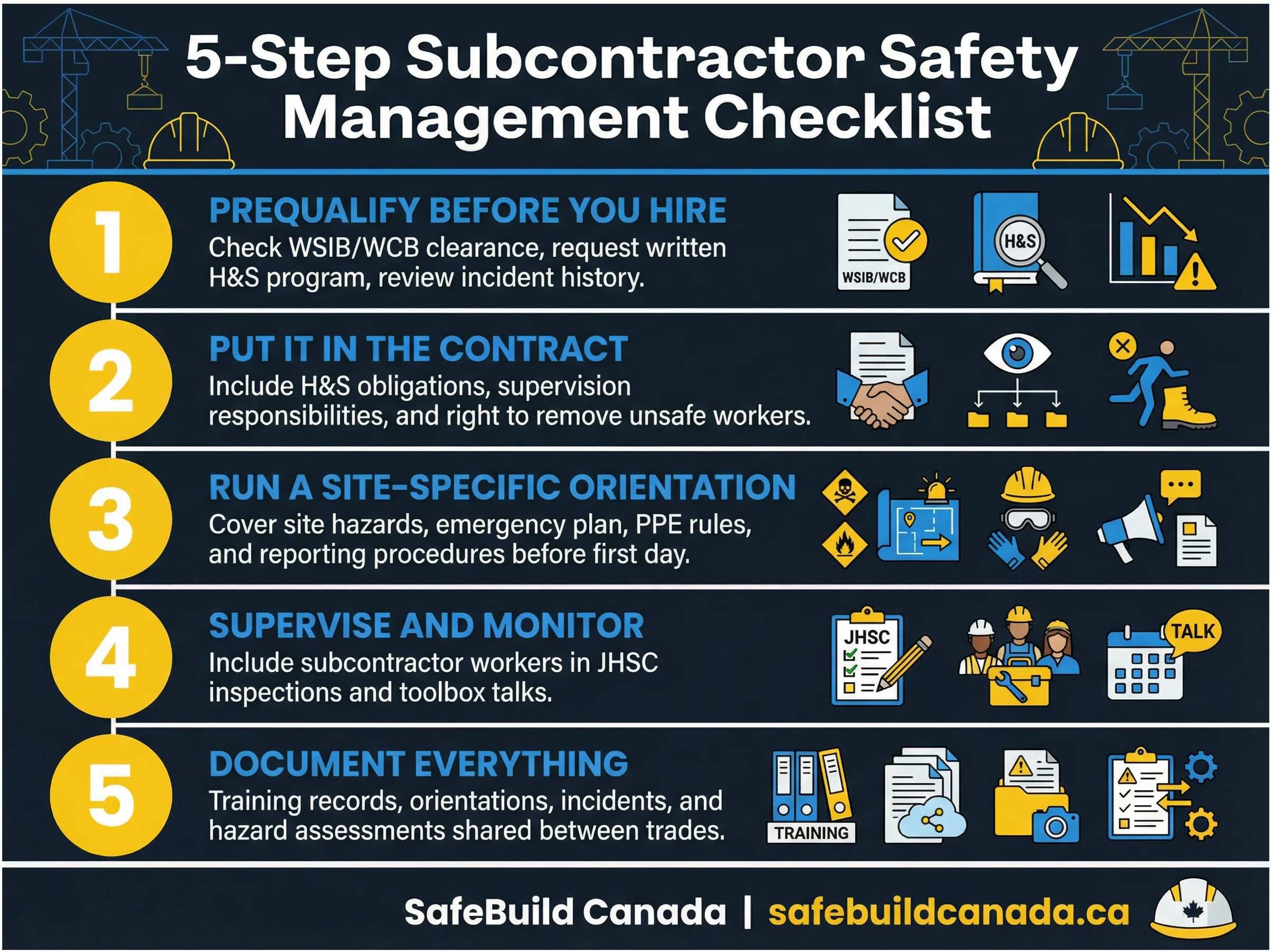
Knowing the legal framework is step one. Building a program that actually works in the field is step two. Here is what that looks like across five areas.
Prequalification before you hire
Before a subcontractor sets foot on your site, you should know their safety record. In Ontario, the WSIB Safety Check tool lets you verify that a contractor is registered and in good standing. In BC, you can request a clearance letter from WorkSafeBC. In Alberta, WCB Alberta provides a similar clearance confirmation.
Beyond clearance, ask for the subcontractor's written health and safety policy and program, their training records for the type of work they will be performing, their incident history for the past three years, and any COR certification if applicable. Document this process. If something goes wrong later and you are asked what due diligence you performed before hiring the sub, you want a paper trail.
Prequalification is not a one-time exercise. A subcontractor who had a clean record two years ago may have had significant turnover or a string of incidents since then. For repeat subs, build a periodic review into your process.
Contract language that reflects reality
The subcontract should spell out health and safety obligations clearly. This means identifying who is responsible for supervising the subcontractor's workers, what the subcontractor's obligations are under the applicable OHS legislation, what the process is for reporting hazards and incidents, and what the GC's right is to remove unsafe workers or stop unsafe work.
This last point matters more than most people realize. If a subcontractor's worker is performing unsafe work and the GC does nothing, the GC is exposed. The contract should give the GC explicit authority to intervene, and the GC should be prepared to use it.
One thing the contract should not try to do is transfer the constructor or prime contractor's statutory duties to the subcontractor. That language is not enforceable under OHS law, and including it can create a false sense of security.
Site-specific orientation
Generic safety orientation is not enough. Every subcontractor worker needs a site-specific orientation before they start work. This covers the specific hazards present on this site, the emergency procedures for this project, the site rules (PPE requirements, smoking areas, vehicle routes, restricted zones), the reporting procedures for hazards and near misses, and who to contact if they have a safety concern.
Sign-in sheets alone are not sufficient proof that orientation occurred. Use a formal orientation record that documents what was covered, who delivered it, and when. Have the worker sign it. Keep it on file.
If your site has a construction site inspection program in place, the orientation process should be tied into it. Inspectors checking your COR audit trail will look for evidence that subcontractor workers received orientation, not just your own employees.
Ongoing supervision and monitoring
The constructor or prime contractor's responsibility does not end after orientation. Subcontractor workers should be included in joint health and safety committee (JHSC) inspections, toolbox talks, and hazard assessments. When a hazard is identified that affects multiple trades, the information needs to get to all of them, not just the employer who created the hazard.
This is where a lot of sites fall short. The GC runs their own toolbox talks, the electrical sub runs theirs, the mechanical sub runs theirs, and nobody is talking to each other about the shared hazards in the middle. The constructor's coordination duty exists precisely to close that gap.
Supervisors from the GC should be walking the site with subcontractor work in mind, not just their own crews. What they observe and what they do about it is attributed to the organization. A supervisor who sees an unsafe condition created by a sub and says nothing has just created a documented failure of the coordination system.
Documentation
The documentation requirements for subcontractor safety management overlap with the general documentation requirements for any COR-compliant safety program. Training records for all workers on site, including subcontractor workers. Orientation records. Incident reports involving subcontractor workers. Hazard assessments shared between trades. The designated substances list required under Ontario OHSA s.30, which must be provided to all subcontractors before they sign a binding contract.
If you are ever subject to an OHS inspection or a post-incident investigation, the question will not just be "did you have a safety program?" It will be "can you show me the records?" If you want to understand what inspectors look for when they arrive on site, the SafeBuild Canada guide on what happens when an OHS inspector visits your construction site covers that process in detail.
The enforcement direction of travel
Enforcement on multi-employer sites has been getting more serious. The CCOHS notes that regulators are increasingly issuing orders to both the constructor and individual employers after incidents, rather than focusing exclusively on the employer whose worker was hurt. The coordination failure is being treated as a distinct violation, separate from whatever the individual employer did or did not do.
This is a meaningful shift. It means that even if a subcontractor's own employer is found to have violated their obligations, the GC can still face orders and fines for failing to coordinate. The two sets of duties are independent.
The practical implication is that having a subcontractor safety management program is no longer just a best practice. It is the minimum standard that regulators expect to see on any multi-employer site. A GC who cannot demonstrate that they prequalified their subs, oriented their workers, monitored compliance, and documented the process is going to have a very difficult conversation after an incident.
Where to start if you do not have a program yet
If your current approach to subcontractor safety is a generic orientation form and a contract clause that says the sub is responsible for their own workers, you have work to do before the next project starts.
Start with the prequalification process. Build a simple checklist: WSIB/WCB clearance, written H&S program, training records, incident history. Run every new sub through it and document the results.
Then look at your contract template. If it does not address supervision responsibilities, the GC's right to intervene, and the subcontractor's specific OHS obligations, get it updated before the next subcontract is signed.
The orientation and documentation pieces can be built incrementally. The important thing is to start, because the legal exposure from having no program is significant, and it only takes one serious incident to make that clear.
Sources
Ontario Ministry of Labour, Constructor Guideline, 2025.
Workplace Safety and Prevention Services (WSPS), 7 tips for meeting your OHS legal duties for contract workers, July 8, 2024.
WorkSafeBC, Prime contractor role and responsibilities (Information Sheet), July 2025.
Government of Alberta, OHS Act and Regulation Code.
Canadian Centre for Occupational Health and Safety (CCOHS), OSH Answers Fact Sheets: Health and Safety Programs.
Infrastructure Health and Safety Association (IHSA), Certificate of Recognition (COR).