
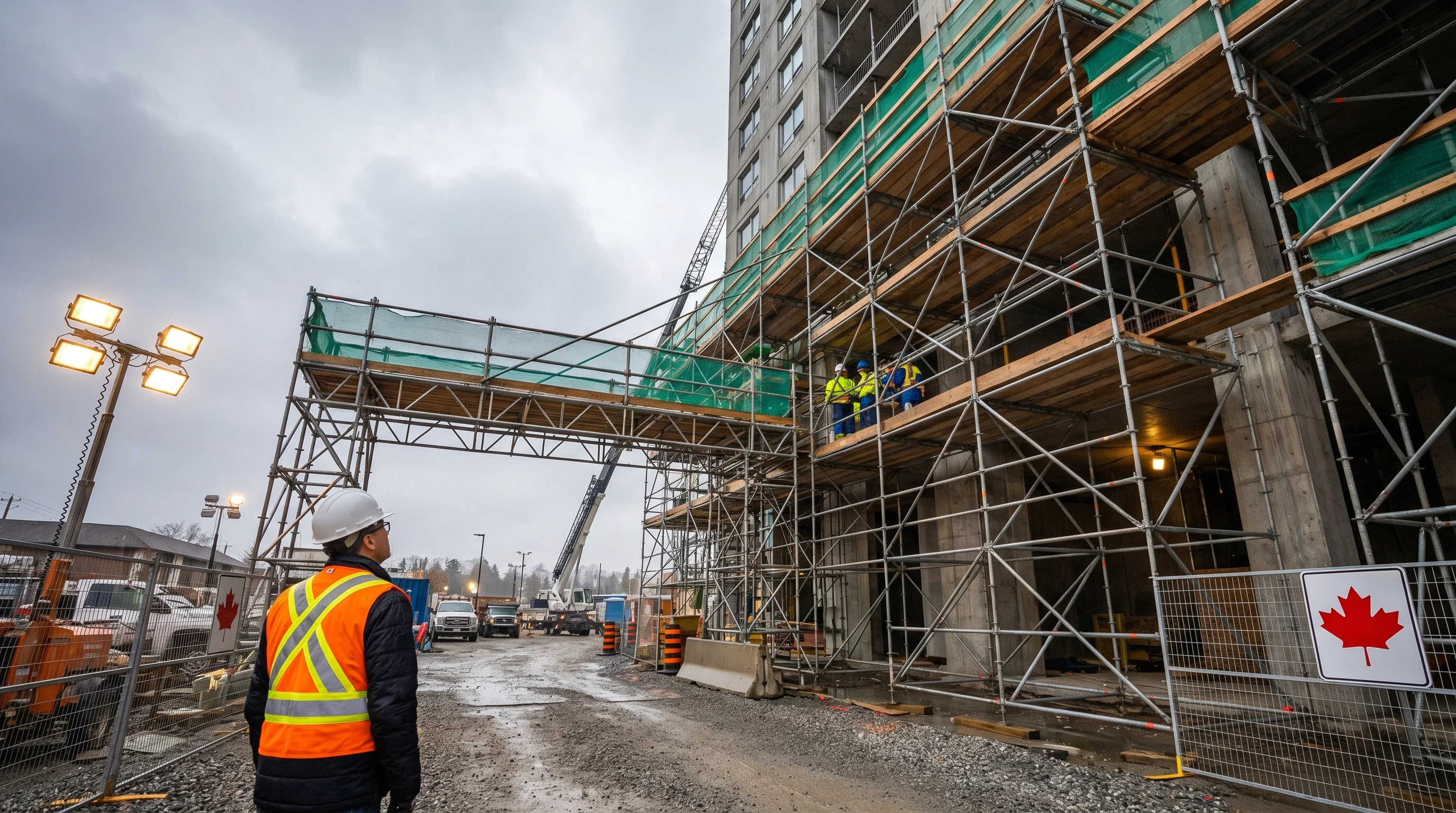
Scaffolding is the backbone of almost every major construction project in Canada. It provides essential access to elevated work areas, allowing tradespeople to perform their duties efficiently. However, when scaffolding is erected improperly, overloaded, or used without adequate fall protection, it becomes one of the most dangerous hazards on a job site. Falls from heights remain a leading cause of fatalities in the Canadian construction industry. According to recent data from WorkSafeBC, falls account for a large percentage of all construction-related deaths.
To combat this, provincial regulators enforce strict rules governing how scaffolds must be designed, inspected, and used. Understanding these rules is a critical component of any construction site safety plan. While the core principles of scaffolding safety are consistent across the country, the specific regulatory thresholds and administrative requirements differ by province. A contractor operating in Toronto faces different compliance triggers than one building in Vancouver or Calgary. This guide breaks down the specific scaffolding safety requirements for Ontario, British Columbia, and Alberta, helping you keep your site compliant and your workers safe. This information should be integrated into your broader construction site safety in Canada: the complete guide protocols.
Ontario: O.Reg. 213/91 requirements
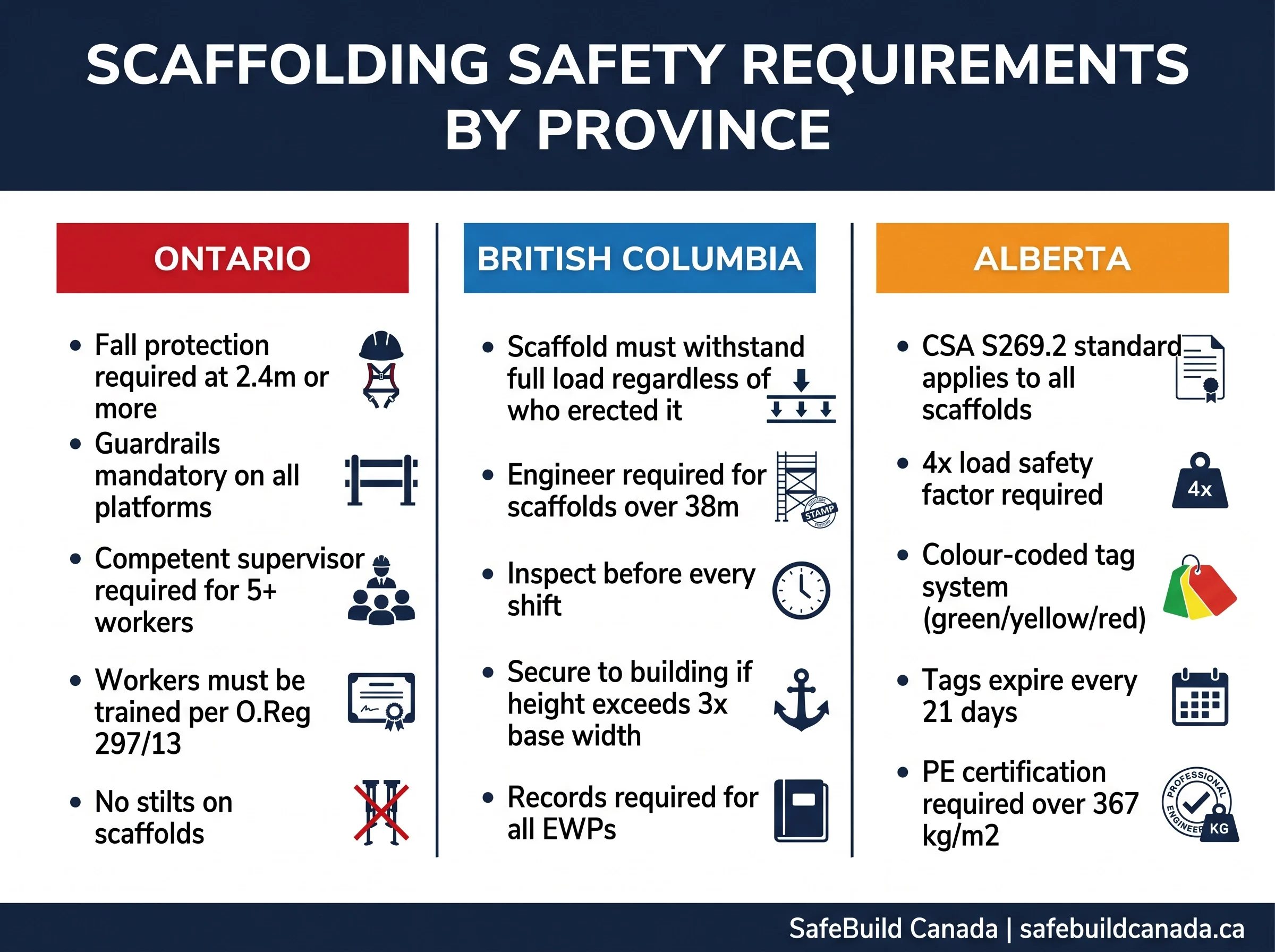
In Ontario, scaffolding safety on construction projects is governed by the Occupational Health and Safety Act under O.Reg. 213/91. The Ministry of Labour, Immigration, Training and Skills Development strictly enforces these rules, and inspectors frequently target scaffolding during site visits. One of the most critical thresholds in Ontario relates to fall protection. Workers must use a full body harness connected to a fall arrest system when working on scaffolds at a height of 2.4 metres or more where guardrails cannot be installed. Working without a fall protection system is only permitted on stationary suspended scaffolds that have guardrails installed in accordance with the regulatory requirements. If you are using a mobile scaffold with a platform higher than 2.4 metres, it must not be moved with a worker on it unless the scaffold is being moved on firm, level ground and the worker is actively using a fall arrest system. This is a common violation that inspectors look for.
Having a proper fall protection plan is essential for compliance. Ontario also places specific responsibilities on supervisors. A constructor must appoint a competent supervisor for the project if five or more workers are working on the site. This supervisor must confirm that nobody uses a scaffold before it is inspected and assessed to meet all design requirements. Furthermore, the use of stilts when working or climbing up and down on a scaffold is explicitly prohibited in Ontario. The scaffold platform itself must be maintained in good order, free of obstructions, ice, and snow, and treated with a material that provides firm footing. Masonry units must be placed directly on the scaffold frames or, if placed on the platform, they must not exceed the load capability of the platform and must be distributed evenly along the scaffold. Suspended scaffolds require particular attention. Every lifeline must be suspended independently from the suspended scaffold, platform, or boatswain's chair and tied up to a fixed support.
Lifelines attached from the suspended scaffold are only permitted if the scaffold has more than one means of support or suspension and the failure of one means of support would not cause the collapse of all or a part of the scaffold. A suspended scaffold must be attached to the fixed support in accordance with the manufacturer's instructions. A multi-point suspended work scaffold must be equipped with movement-limiting devices to prevent unintended movement when the scaffold is traversed. Signs indicating the live loads of a multi-point suspended work platform must be posted in conspicuous places on the scaffold. Wind speed must be monitored, and the multi-point suspended work platform must not be operated, traversed, or moved if the speed of the wind is higher than the speed specified on the design drawing at which the work should stop.
British Columbia: WorkSafeBC Part 13
In British Columbia, scaffolding regulations are detailed in Part 13 of the WorkSafeBC Occupational Health and Safety Regulation. WorkSafeBC places a strong emphasis on structural integrity and engineering oversight. The employer must verify that scaffolds used by workers are in a safe condition and are able to withstand the load, regardless of who actually erected the scaffold. This means you cannot simply rely on the scaffolding contractor; the employer whose workers are using the structure bears ultimate responsibility for verifying its safety. WorkSafeBC requires professional engineering instructions and certification for several specific scaffolding scenarios. An engineer must be involved if a scaffold exceeds 38 metres in height, or if it exceeds 25 metres in height and includes stairways.
Engineering is also required for scaffolds used to support a temporary floor, scaffolds supporting a crane or hoist, and any suspended, cantilevered, or outrigger scaffolds. Inspection requirements in BC are rigorous. A ladder, window cleaner's belt, work platform, and all associated components must be inspected before use on each shift, and after any modification. Any condition that might endanger workers must be remedied before the equipment is used. Employers must also keep detailed records of inspection, maintenance, repair, or modification for elevating work platforms and swing stages. A work platform must be removed from service until certified safe for use by the manufacturer or a professional engineer if it has been subjected to a sudden drop, been in contact with exposed energized electrical equipment or conductors, or shows signs of any kind of structural or mechanical damage or substantial wear. A scaffold must be erected with the vertical members plumb, and with the ledgers and bearers level.
The base of a scaffold must have bearing plates or sills that rest on a solid surface and are sufficient to support the weight of the scaffold. The poles, legs, and uprights of a scaffold must be securely and rigidly braced to prevent movement. A scaffold must be effectively guyed or secured to a building or structure if the height of the scaffold exceeds three times its minimum base dimension, or in any other circumstances if required for stability. Unless otherwise specified by the manufacturer, height adjustment devices must not extend more than two-thirds of their total length or 60 centimetres, whichever is less. All connections between the parts of a scaffold must be secure.
Alberta: OHS Code Part 23
Alberta's approach to scaffolding safety, outlined in Part 23 of the Occupational Health and Safety Code, relies heavily on standardized tagging systems and strict load calculations. Alberta explicitly requires that scaffolds erected to provide working platforms comply with CSA Standard CAN/CSA S269.2-M87 (R2003), Access Scaffolding for Construction Purposes. The code mandates a strong safety factor: an employer must confirm that a scaffold is designed and constructed to support at least four times the load that may be imposed on it. Furthermore, the actual load to which a scaffold is subjected must never exceed one quarter of the load for which it is designed. If a scaffold is used to carry the equivalent of an evenly distributed load of more than 367 kilograms per square metre, it must be designed and certified by a professional engineer. All workers on a scaffold must be informed of the maximum load that the scaffold is permitted to carry.
Alberta uses a unique and mandatory colour coded tagging system at each point of entry to indicate a scaffold's status. A green tag indicates it is safe for use. A yellow tag indicates caution due to a potential or unusual hazard. A red tag indicates it is unsafe for use. A scaffold must be inspected and tagged by a competent worker before it is used for the first time and at intervals of not more than 21 calendar days. A worker must not use a scaffold if it has a red tag, an expired tag, or no tag at all. An employer must confirm that a single pole or double pole scaffold is supported against lateral movement by adequate bracing, anchored by one tie-in for each 4.6 metre vertical interval and one tie-in for each 6.4 metre horizontal interval, and set plumb on a base plate, jackscrew, or other load dispersing device on a stable surface.
If the scaffold is hoarded, it must be anchored by one tie-in for each 3 metre vertical interval and one tie-in for each 3 metre horizontal interval. An employer must confirm that ropes or wire ropes used in scaffolding are protected against fraying or other damage, and made of heat or chemical resistant material if there is a possibility of exposure to heat or chemicals. Wooden scaffolds must be constructed of unpainted dressed lumber. If scaffolding or a temporary work platform can be damaged by powered mobile equipment or a vehicle contacting it, an employer must take reasonable measures to protect the scaffolding or temporary work platform from being contacted.
Universal safety requirements for all scaffolding work
Regardless of which province you operate in, certain fundamental safety practices apply universally. Proper hazard identification and risk assessment must be conducted before any scaffolding is erected. This includes assessing ground conditions, checking for overhead power lines, and determining the appropriate type of scaffold for the specific task.
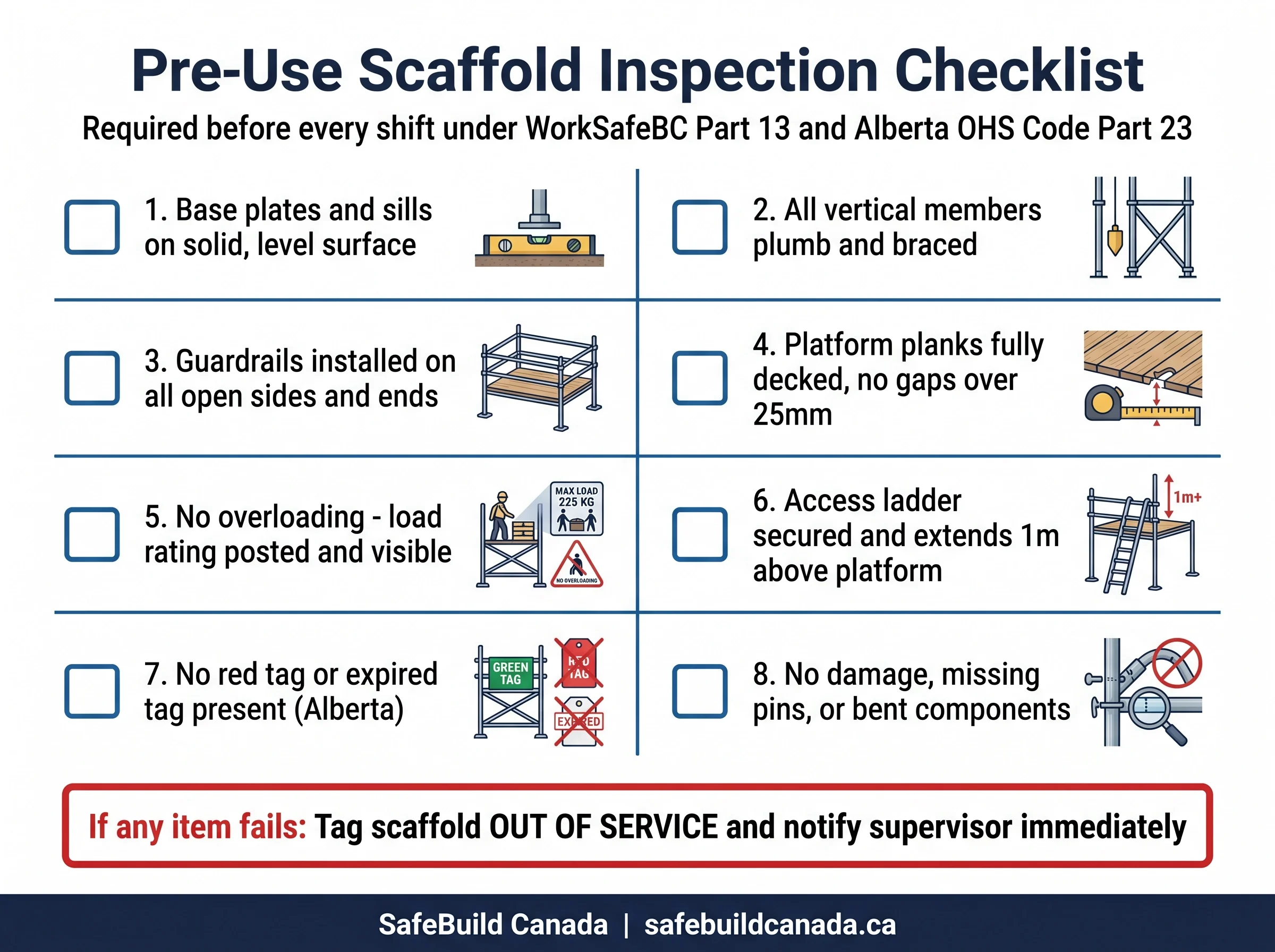
Base plates and sills are critical. The base of a scaffold must rest on a solid surface sufficient to support the weight of the scaffold and its intended load. Scaffolds must be erected with vertical members plumb and ledgers level. Bracing is essential to prevent lateral movement, and scaffolds must be tied into the building structure at the intervals specified by provincial regulations or manufacturer instructions.
Platform construction is another common area for violations. Scaffold planks must be of appropriate grade and size, fully decked to prevent gaps, and secured against movement. Workers must be provided with proper access, typically via secured ladders that extend at least one metre above the platform. Finally, confirm all workers are equipped with the appropriate gear as outlined in the CSA PPE standards for Canadian construction.
When erecting, dismantling, or altering a scaffold, workers must be protected from falling. This often requires the use of a personal fall arrest system, even if guardrails will eventually be installed. The area below the scaffold should be barricaded or marked with warning signs to protect other workers from falling objects.
Regular inspections are the most effective way to maintain scaffold safety. A competent person should inspect the scaffold before each shift, after any modifications, and after any severe weather events. The inspection should cover all components, including base plates, uprights, ledgers, bracing, platforms, guardrails, and access points. Any damaged or defective components must be replaced immediately.
Training is also paramount. All workers who erect, dismantle, alter, or use scaffolds must receive adequate training. This training should cover the specific hazards associated with scaffolding, the proper use of fall protection equipment, and the procedures for inspecting and maintaining the scaffold. By investing in training, employers can empower their workers to identify and address safety issues before they lead to accidents.
By understanding the specific regulations in your province and implementing rigorous inspection and training programs, you can reduce the risk of scaffolding incidents and create a safer work environment for your entire team.
Sources
Ontario O.Reg. 213/91: Construction Projects
WorkSafeBC OHS Regulation Part 13: Ladders, Scaffolds and Temporary Work Platforms
Alberta OHS Code Part 23: Scaffolds and Temporary Work Platforms
CCOHS: Platforms and Scaffold Use
WorkSafeBC: Falls from heights prevention