
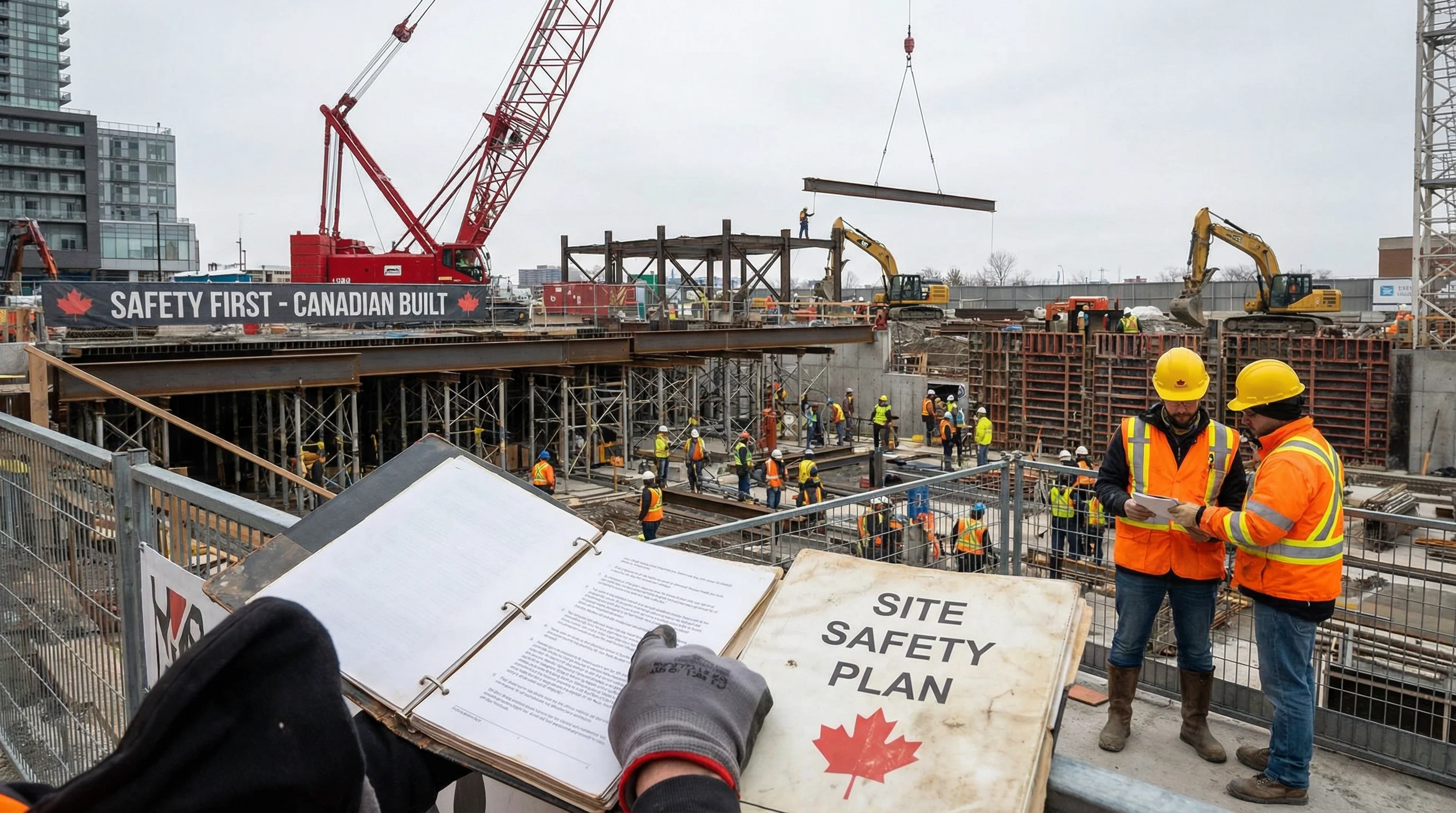
Most construction site safety plans in Canada share the same flaw: they were written once, filed in a binder, and never looked at again. The plan exists. Workers do not know what is in it. Supervisors have not reviewed it since the project started. When an inspector arrives or an incident happens, everyone scrambles to find the document.
A safety plan is not a filing exercise. It is the operating system for how your site manages risk, and it only works if it is built properly, communicated clearly, and updated as the site changes. This guide walks through what Canadian law actually requires, what every plan must include, and how to build one that functions in the real world rather than sitting on a shelf.
Why construction sites need a different kind of safety plan
A construction site is not a factory. The hazards change every day as the project progresses. The workforce rotates: a framing crew finishes and leaves, an electrical crew arrives, a concrete subcontractor works alongside both of them. The site itself is temporary, exposed to weather, and often adjacent to the public. These conditions make construction safety planning fundamentally different from writing a generic workplace health and safety policy.
The four factors that make construction safety planning genuinely complex are the rotating workforce, the multi-employer environment, the evolving site conditions, and the concentration of high-hazard work. A plan that does not account for all four is not a construction safety plan. It is a general industry template with a project name on the cover.
The other thing that makes construction different is the legal structure. In Ontario, the law places overall responsibility on the "constructor," which is the company that contracts directly with the owner. In British Columbia and Alberta, that role is called the "prime contractor." The distinction matters because it determines who is legally accountable when a subcontractor's worker gets hurt. Understanding that structure is the starting point for building a plan that actually reflects how your site operates.
There is also the question of what happens when the plan is absent or inadequate. The Ministry of Labour in Ontario, WorkSafeBC, and Alberta OHS all conduct proactive inspections of construction sites. When an inspector finds a site without a current, site-specific safety plan, the consequences range from compliance orders to stop-work orders. When a serious incident occurs on a site with no plan, the legal exposure for the constructor or prime contractor is significant. The plan is not just good practice. It is the documented evidence that you took your legal obligations seriously.
What Canadian law requires
The legal requirements for a construction site safety plan vary by province, but three themes run through every jurisdiction: someone must be accountable, hazards must be identified before work starts, and workers must be told about the hazards that affect them.
Ontario
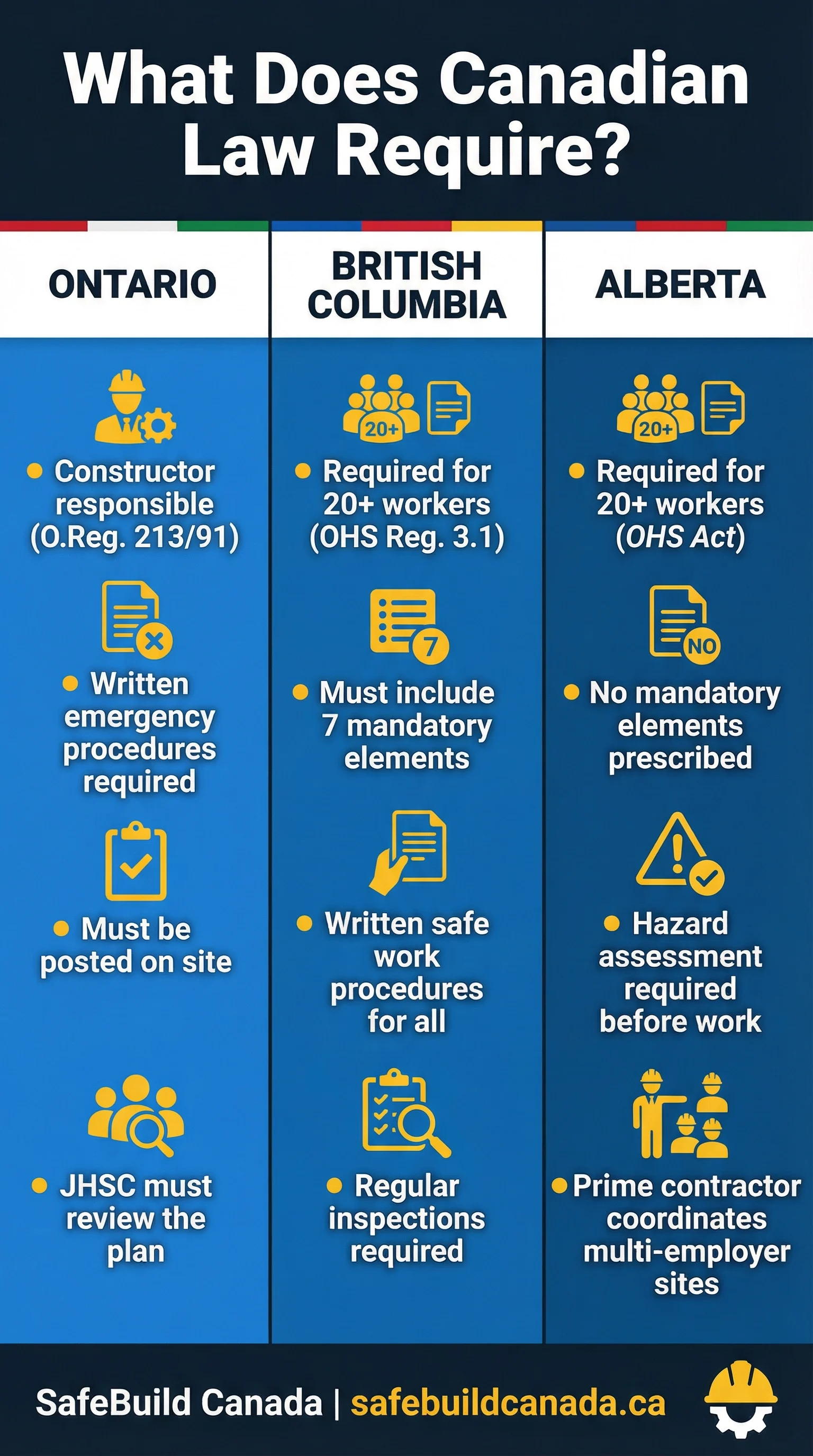
Ontario's construction safety requirements sit primarily in O.Reg. 213/91: Construction Projects under the Occupational Health and Safety Act. Section 17 requires the constructor to establish written emergency procedures for the project before work begins. Those procedures must be reviewed with the joint health and safety committee (JHSC) or health and safety representative (HSR), and they must be posted in a conspicuous place on the site.
The OHSA itself adds the broader framework. Under section 25, an employer must take every precaution reasonable in the circumstances to protect workers. Under section 26, supervisors must ensure workers comply with the Act and regulations. These are not aspirational statements. They are the legal standard against which your plan will be measured if something goes wrong.
Ontario does not prescribe a single mandatory format for a construction safety plan, but the combination of the constructor's duty of care, the emergency procedures requirement, and the JHSC review obligation effectively defines the minimum scope. A constructor who cannot produce a written safety plan during an inspection is not in a strong legal position.
British Columbia
BC's OHS Regulation Part 3 is the most prescriptive of the three provinces. Section 3.1 requires any employer with 20 or more workers to have a written OHS program. Section 3.3 specifies seven mandatory elements that program must contain.
Those elements are: a statement of the employer's aims and the responsibilities of the employer, supervisors, and workers; provision for regular inspection of premises, equipment, work methods, and work practices; written instructions available to all workers to supplement the OHS Regulation; provision for periodic management meetings to review health and safety activities and incident trends; provision for prompt investigation of incidents to prevent recurrence; maintenance of records and statistics, including inspection and investigation reports; and provision for the instruction and supervision of workers in the safe performance of their work.
Employers with fewer than 20 workers are not exempt. They must have written safe work procedures and a system for identifying and responding to hazards. The threshold affects the formality of the program, not the obligation to manage hazards.
Alberta
Alberta's OHS Act requires employers with 20 or more regularly employed workers to have a health and safety program, as outlined on the Government of Alberta's health and safety program page. Unlike BC, Alberta does not prescribe mandatory elements. Employers have flexibility to develop programs that suit their workplace, provided the program addresses the mandatory requirements within OHS legislation, including hazard assessment, health and safety committees, and worker training.
For employers with fewer than 20 workers, the requirement is documentation that meets OHS legislation requirements: a hazard assessment, an emergency response plan, and evidence of worker involvement. The prime contractor on a multi-employer site has additional duties to establish a system for cooperation between employers on health and safety matters.
The Canadian Centre for Occupational Health and Safety provides a framework for what a complete OHS program should contain regardless of province, and it is worth reviewing alongside your provincial requirements rather than instead of them.
The 10 sections every construction site safety plan needs
The legal minimums tell you what you cannot skip. They do not tell you what a functional plan looks like. The following 10 sections are what a complete construction site safety plan should contain, regardless of province.
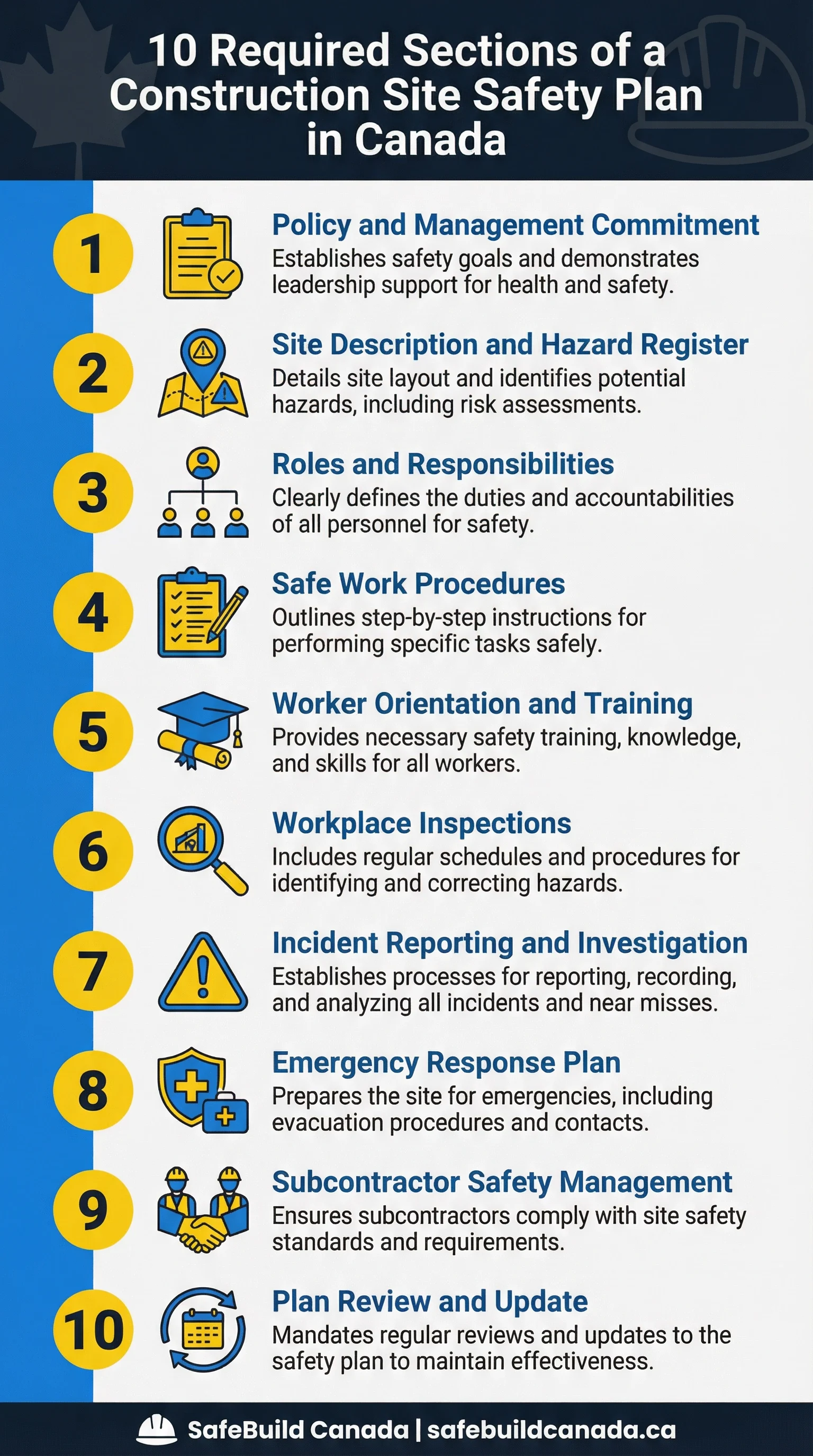
Section 1: Policy and management commitment
The plan opens with a signed safety policy statement from the highest level of management available on the project. This is not a formality. A policy statement that has been signed by the project owner or senior site manager signals to every worker and subcontractor that safety decisions have organizational backing.
The policy should state the company's commitment to providing a safe workplace, acknowledge the legal obligations under the applicable provincial OHS legislation, and identify who is responsible for safety on this specific project. It should be dated and reviewed annually or when the project scope changes significantly. A policy that was signed five years ago and has not been touched since is not evidence of management commitment. It is evidence of management indifference.
Section 2: Site description and hazard register
This section is where the plan becomes site-specific. It should include the project address, a brief description of the scope of work, the anticipated project duration, and a list of the major trades and subcontractors who will be on site.
More importantly, it must contain a hazard register: a systematic identification of the hazards present on this site, the risk level of each hazard, and the controls in place to eliminate or reduce that risk. The hazard register is a living document. It should be updated when new trades arrive, when site conditions change, and after any incident or near miss. A thorough approach to hazard identification and assessment in Canadian construction is the foundation everything else in the plan rests on.
The hazard register should not be a generic list of construction hazards copied from a template. It should reflect the specific conditions on this site. A project involving excavation near an existing building has different hazards from a project involving steel erection on a greenfield site. The plan should reflect that difference.
Section 3: Roles and responsibilities
Every person on the site needs to know what they are responsible for when it comes to safety. This section defines those responsibilities clearly.
The constructor or general contractor is responsible for the overall safety of the project, including the safety of subcontractor workers. Supervisors are responsible for ensuring workers under their direction follow the plan and the applicable regulations. Workers are responsible for working safely, using required PPE, and reporting hazards. Subcontractors are responsible for their own workers and for complying with the site safety plan. The JHSC or HSR has specific rights and responsibilities under provincial legislation that must be reflected here.
The section should also name the designated site safety officer or supervisor, the first aid attendant, and the emergency response coordinator. Roles without names attached are not accountable. "The supervisor" is not a name. "Maria Chen, site supervisor" is.
Section 4: Safe work procedures
Safe work procedures (SWPs) are the written instructions for how specific high-risk tasks will be performed safely on this site. They are not generic descriptions of how a task is normally done. They are site-specific instructions that account for the particular conditions, equipment, and hazards present on this project.
Every construction site should have SWPs for the high-hazard activities present on that site. At minimum, most projects will need SWPs for working at heights, operating heavy equipment, excavation and trenching, lockout/tagout, confined space entry, and working near overhead powerlines. The specific list depends on the scope of work.
SWPs should be written in plain language, reviewed with the workers who will use them, and kept accessible on site. A procedure that workers have never read is not a procedure. It is a document that provides legal cover without providing actual protection.
Section 5: Worker orientation and training
Every worker who comes onto the site must receive a site orientation before they start work. The orientation should cover the site layout, the emergency muster point and evacuation procedure, the location of first aid resources, the site-specific hazards identified in the hazard register, the PPE requirements for the site, and who to contact if they have a safety concern.
Beyond orientation, the plan should document the training requirements for the work being performed. In Ontario, workers performing work at heights must hold a valid Working at Heights training certificate from a provider approved by the Ministry of Labour. WHMIS 2015 training is required for workers who may be exposed to hazardous products. First aid training requirements vary by province and by the number of workers on site.
The training section should include a log where worker names, training completed, and certificate expiry dates are recorded. This is not administrative overhead. It is the evidence you need if a Ministry inspector asks whether your workers are qualified to do the work they are doing. For a full breakdown of WHMIS 2015 requirements for Canadian construction sites, the SafeBuild Canada guide covers the specific obligations for construction employers.
Section 6: Workplace inspections
Regular workplace inspections are required under every provincial OHS regime. The plan should specify the frequency of inspections, who is responsible for conducting them, and what form or checklist will be used.
At minimum, most construction sites should conduct a pre-shift inspection of the work area and equipment each morning, a formal weekly site inspection by the supervisor or safety officer, and a JHSC inspection at the frequency required by provincial legislation (monthly in Ontario for most construction projects). Inspection records must be kept on file. They are one of the first things a Ministry inspector will ask to see, and they are also one of the most useful tools for identifying hazard trends before they result in an incident.
A site that has been conducting weekly inspections for six months has a documented record of what hazards were identified, what corrective actions were taken, and whether those actions were effective. That record is valuable in its own right, and it is also the kind of evidence that demonstrates due diligence if the site is ever the subject of a Ministry investigation. For sites moving from paper to digital records, the SafeBuild Canada guide on running a construction site inspection program in Canada covers how to structure an inspection program that satisfies both the COR audit trail and provincial inspection requirements.
Section 7: Incident reporting and investigation
This section defines what happens when something goes wrong. It should cover the internal reporting procedure (who to notify, in what timeframe, using what form), the regulatory reporting requirements (which incidents must be reported to WorkSafeBC, the Ministry of Labour, or Alberta OHS, and within what timeframe), and the investigation procedure.
The investigation procedure matters more than most employers realize. A proper investigation does not stop at identifying what happened. It asks why the conditions that allowed the incident to occur existed in the first place. The construction site emergency response and incident management guide on SafeBuild Canada covers the investigation process in detail, including the difference between a time-bound order and a stop-work order after a serious incident.
Near misses deserve the same attention as incidents that result in injury. A near miss is a warning that the system is not working. Treating it as a close call that did not matter is how sites end up with serious injuries that were entirely predictable.
Section 8: Emergency response plan
The emergency response plan (ERP) is a mandatory component under Ontario O.Reg. 213/91 and a practical necessity on every construction site regardless of province. It should identify the emergency scenarios most likely on this specific site (fire, medical emergency, chemical spill, structural collapse, powerline contact, severe weather), the response procedure for each scenario, the emergency contacts (911, the local utility company, poison control, the nearest hospital), the location of the muster point, and the location of first aid equipment.
The ERP must be posted in a visible location on the site. Workers must be told where it is and what to do in an emergency before they start work. Running a drill at least once during a long project is good practice. Workers who have never thought through what they would do in an emergency are not prepared for one, regardless of what the posted procedure says.
The ERP should also address the communication plan: who notifies the Ministry or WorkSafeBC after a serious incident, who contacts the worker's family, and who speaks to the media if the incident attracts public attention. These are not comfortable things to plan for, but they are far better planned in advance than improvised in the immediate aftermath of a serious event.
Section 9: Subcontractor safety management
On any project with multiple employers, the plan must address how subcontractor safety will be managed. This section should define the pre-qualification requirements for subcontractors (what safety documentation they must provide before being awarded work), the orientation requirements for subcontractor workers, the supervision and monitoring process, and the procedure for addressing non-compliance.
The legal principle here is important: the constructor or prime contractor cannot transfer their OHS responsibility to a subcontractor through a contract. The subcontractor safety management guide on SafeBuild Canada explains the legal framework in detail, but the short version is that actual control of the work determines legal responsibility, not the wording of the subcontract. A GC who awards a contract to a subcontractor and then pays no attention to how that subcontractor manages safety is not protected by the contract language.
Section 10: Plan review and update
A safety plan that is never updated is a plan that stops reflecting reality. This section should specify the trigger events that require the plan to be reviewed and updated: a new trade arriving on site, a significant change in scope, an incident or near miss, a change in applicable legislation, and an annual review at minimum.
The JHSC or HSR should be involved in plan reviews. Their involvement is not just a legal requirement in most provinces. It is also the most reliable way to ensure the plan reflects what is actually happening on the site rather than what management thinks is happening. Workers and their representatives often have the clearest view of where the gaps are.
The difference between a plan and a system
Writing a safety plan and building a safety system are two different things. A plan is a document. A system is the set of habits, conversations, inspections, and decisions that happen every day on the site.
The most common failure mode is treating the plan as a compliance artifact rather than an operational tool. The plan gets written before the project starts, submitted to the owner or the Ministry if required, and then filed. Workers never see it. Supervisors do not refer to it. When conditions change, no one updates it.
The sites that have strong safety records are the ones where the plan is a reference document that supervisors actually use. The hazard register gets updated when a new trade arrives. The inspection checklist gets pulled out every Monday morning. The incident investigation procedure gets followed when there is a near miss, not just when there is a serious injury.
That shift from plan-as-document to plan-as-system does not require a dedicated safety officer or a large company. It requires a supervisor who takes the plan seriously and a management team that backs them up when safety decisions create friction with the schedule.
There is a version of this that I find genuinely frustrating to see on sites: a beautifully formatted, professionally bound safety plan that has clearly never been used. The binder is clean. The pages are uncreased. The hazard register was filled out before the project started and has not been touched since. That binder is not a safety system. It is a liability document that creates the appearance of compliance without any of the substance.
Common mistakes to avoid
There are several patterns that appear repeatedly in construction safety plans that do not work.
The first is the generic template problem. A plan that was downloaded from the internet and had the company name and project address filled in is not a site-specific safety plan. It does not reflect the actual hazards on the site, the actual roles of the people on the project, or the actual emergency contacts for this location. Inspectors can tell the difference immediately. More importantly, workers can tell the difference, and a generic plan communicates that safety is a box-checking exercise rather than a genuine priority.
The second is the missing hazard register. Many plans have a policy statement, a list of responsibilities, and an emergency procedure, but no systematic identification of the site-specific hazards. The hazard register is the analytical core of the plan. Without it, the safe work procedures have no foundation and the inspection program has no focus.
The third is the subcontractor gap. The plan covers the GC's own workers but says nothing about how subcontractor workers will be oriented, supervised, or held accountable. On a multi-trade project, this is the gap where most incidents happen. The GC's workers know the site. The subcontractor's workers arrived this morning and have not been briefed on the site-specific hazards.
The fourth is the update failure. The plan was accurate on day one of the project. Six months later, the scope has changed, three new subcontractors have arrived, and a new hazard has been identified. The plan still reflects day one. This is not a minor administrative issue. It is a legal exposure and a practical safety failure.
The fifth is the communication failure. The plan exists, it is reasonably current, and it is filed in the site office. Workers have never seen it. They could not tell you what the emergency muster point is, who the first aid attendant is, or what the procedure is if they find a hazard they are not sure how to handle. A plan that has not been communicated is not a plan. It is a document.
Getting started
If your company does not have a construction site safety plan, or if the one you have is a generic template that has not been reviewed since it was written, the place to start is the hazard register. Walk the site. Identify the hazards that are actually present. Document them. Assign controls. That exercise alone will tell you more about the safety gaps on your project than any template ever will.
From there, build the plan section by section using the framework above. Involve your supervisors in writing the safe work procedures. Have your JHSC or HSR review the plan before you finalize it. Post the emergency response plan where workers can find it. Brief every worker on the plan during their site orientation.
The plan does not need to be long. It needs to be accurate, specific, and used. A ten-page plan that supervisors refer to every week is more valuable than a fifty-page binder that no one has opened since the project started.
For companies looking at the broader regulatory framework that governs construction safety planning across Canada, the SafeBuild Canada guide to OHS regulations in Canada for construction employers covers the provincial and federal legislative framework in detail. And if you are working toward a Certificate of Recognition (COR), the safety plan is one of the core elements auditors will examine. Getting it right from the start of the project is considerably easier than rebuilding it under audit pressure.
The construction industry in Canada has made real progress on safety over the past two decades. Fatality rates have declined. Awareness of psychological safety has grown. Digital inspection tools have made it easier to document and track hazards in real time. None of that progress changes the fundamental requirement: every construction site needs a written safety plan that reflects the actual conditions on that site, is communicated to the people who work there, and is updated when conditions change. That is not a high bar. It is the minimum.
Sources
Ontario Government. O. Reg. 213/91: Construction Projects. Ontario e-Laws, consolidated to March 11, 2026.
WorkSafeBC. OHS Regulation Part 3: Rights and Responsibilities. WorkSafeBC, 2025.
Government of Alberta. Health and safety program. Alberta.ca, 2025.
Canadian Centre for Occupational Health and Safety. Health and Safety Program: General Elements. CCOHS OSH Answers Fact Sheet, 2024.
Infrastructure Health and Safety Association. Construction Health and Safety Manual (M029). IHSA, current edition.
WorkSafeBC. OHS Regulation Section 3.3: Contents of program. WorkSafeBC, 2025.