
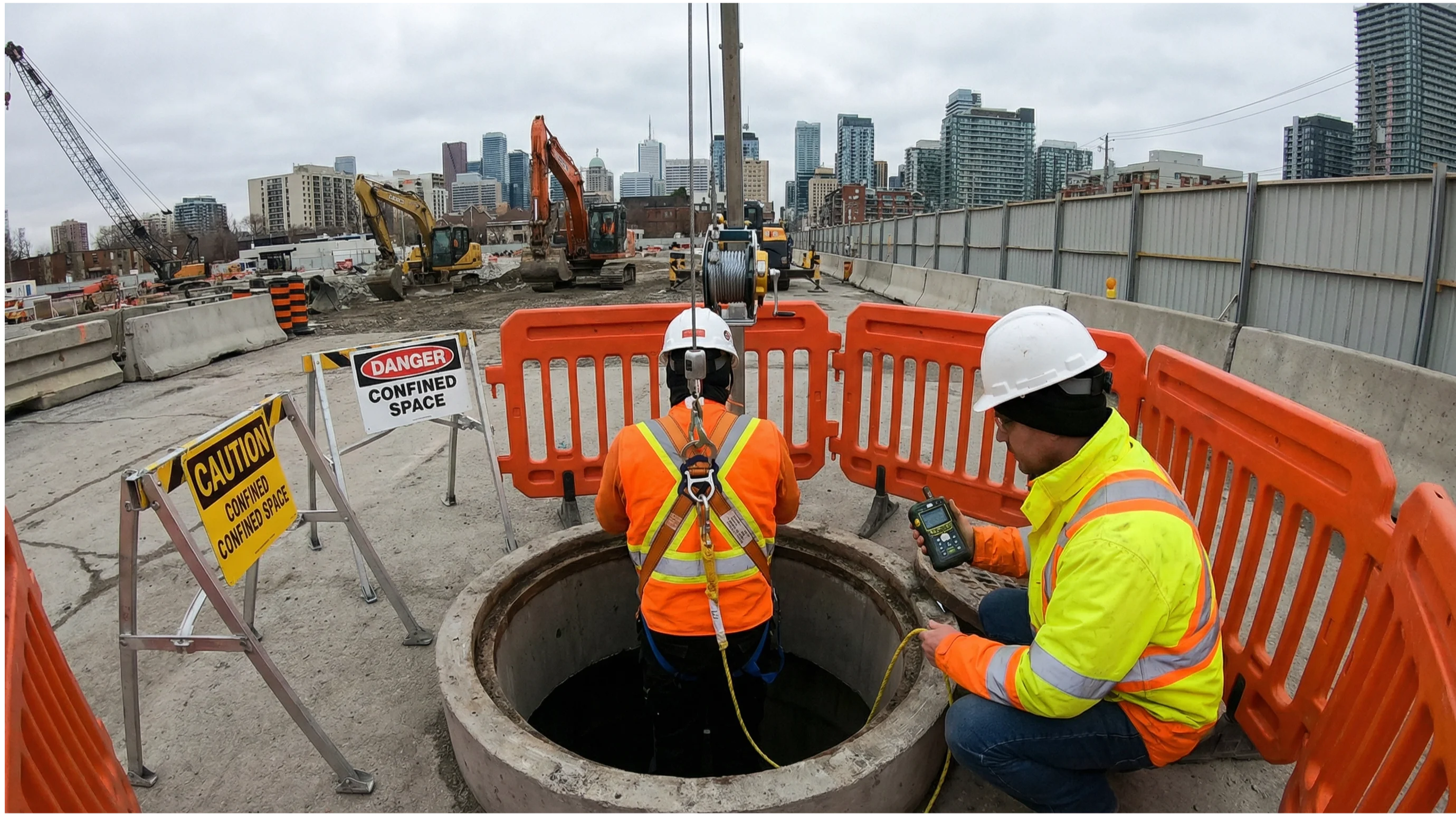
Confined space entry in Canadian construction: what the law requires and why the rescue rule matters most
Between 2011 and 2015, Canadian workplaces recorded nearly 12,000 lost-time injuries tied to confined space incidents, along with 14 fatalities. That number is grim on its own. What makes it worse is this: according to the Canadian Centre for Occupational Health and Safety, more than 60% of those who died in confined spaces were not the original entrants. They were coworkers who went in to help, without proper training, without the right equipment, and without a rescue plan that would have told them not to enter at all.
Confined space entry is one of the most regulated activities in Canadian construction, and for good reason. The hazards are invisible, the consequences are immediate, and the instinct to help a colleague in distress can be fatal if it overrides procedure. This article walks through what Canadian OHS law actually requires, where most construction sites fall short, and why the rescue plan is the piece that deserves the most attention. For a broader view of how confined space entry fits into your overall obligations, the construction site safety guide covers the full range of site-level requirements across Canadian jurisdictions.
What counts as a confined space on a construction site
The legal definition of a confined space varies slightly by province, but the core concept is consistent across Canadian jurisdictions. In British Columbia, WorkSafeBC's OHS Regulation Part 9 defines a confined space as an area that is enclosed or partially enclosed, is not designed or intended for continuous human occupancy, has limited or restricted means for entry or exit that may complicate emergency response, and is large enough for a worker to enter to perform assigned work.
Ontario's Confined Spaces Regulation (O.Reg. 632/05) uses a three-part test: the space must be partially or fully enclosed, must not be both designed and constructed for continuous human occupancy, and must be a place where atmospheric hazards may occur because of its construction, location, or contents, or because of work being done in it. All three criteria must be met.
On a typical Canadian construction site, spaces that meet these definitions include manholes and utility vaults, sewers and storm drains, caissons and cofferdams, tunnels and shafts, storage tanks and vessels, crawl spaces under structures, and pipe sections and culverts. A space does not need to be small to qualify. A large concrete vault that a worker can walk into is still a confined space if it meets the definition, and it carries the same legal obligations as a narrow pipe.
The written confined space entry program
Before any worker enters a confined space, every Canadian jurisdiction requires the employer to have a written confined space entry program in place. In BC, WorkSafeBC Section 9.5 requires the program to include an assignment of responsibilities, a list of each confined space or group of similar spaces with a hazard assessment, and written safe work procedures covering identification and entry permits, lockout and isolation, verification and testing, ventilation, standby persons, rescue, lifelines and harnesses, PPE, and coordination of work activities.
Ontario's O.Reg. 632/05 requires the program to include a method of recognizing each confined space, a method for assessing hazards, a method for developing hazard control plans, a method for training workers, and an entry permit system. The Ontario regulation also requires that the program be developed in consultation with the joint health and safety committee or health and safety representative for non-construction workplaces.
The written program is not a one-time document. It must be reviewed and updated whenever a new confined space is identified, whenever conditions change, and whenever a near-miss or incident occurs. Treating it as a filing cabinet exercise rather than a living document is one of the most common compliance failures WorkSafeBC and Ontario's Ministry of Labour identify during inspections. If your site already has a construction site safety plan, the confined space program should be integrated into it as a dedicated section rather than maintained as a standalone document.
Hazard assessment before every entry
A written program is the foundation, but the hazard assessment is what makes each individual entry safe. Both BC and Ontario require a competent person to conduct a written hazard assessment before each entry, not just when the program is first written.
The assessment must consider the hazards that exist in the space at the time of entry, the hazards that may develop while work is being performed, and the general safety hazards present. In practice, this means thinking through what was previously stored in the space, what work activities will introduce new hazards, whether adjacent piping or equipment could introduce harmful substances, and whether the work itself (welding, painting, using power tools) will change the atmosphere.
The assessment determines whether an entry permit is required. In some jurisdictions, a permit is required for every confined space entry. In others, it is required when the hazard assessment determines that controls such as atmospheric monitoring, isolation, lockout, ventilation, or respiratory protection are needed. In practice, most confined spaces on construction sites will require a permit. The hazard identification and risk assessment process that governs your broader site operations applies directly here, and the confined space hazard assessment should follow the same documented format.
The entry permit and what it must contain
The entry permit is the administrative record that documents everything checked, tested, and authorized before a worker entered the space. According to CCOHS guidance, a properly completed entry permit must include: the permit validity period, names of authorized entrants, attendant name, responsible supervisor, confined space location and description, scope of work, all hazards inside and outside the space, date and time of entry and anticipated exit, atmospheric testing results and calibration dates, hazard control measures (ventilation, PPE, work procedures), communication methods between entrants and attendant, the emergency and rescue plan, the atmospheric testing signature, and the supervisor authorization signature.
The permit must be posted at the confined space opening and remain posted until work is complete. A copy must be kept on file by the employer. This is not paperwork for its own sake. When an incident occurs and WorkSafeBC or the Ontario Ministry of Labour investigates, the entry permit is the first document they ask for. A missing or incomplete permit is both a regulatory violation and a signal that the entire program may not have been followed.
Atmospheric testing: the step that cannot be skipped
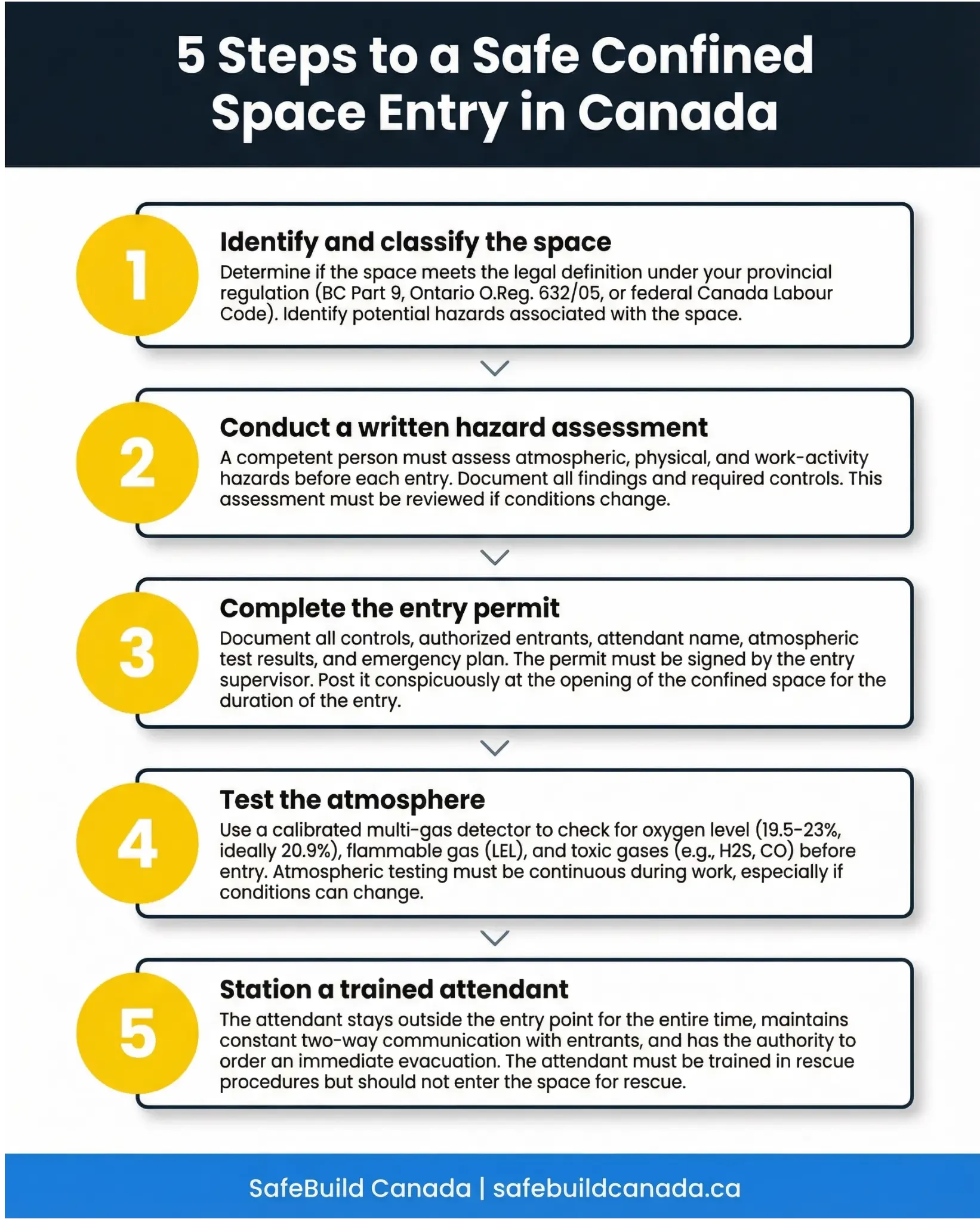
Atmospheric hazards cause 62% of all confined space accidents in Canada, and 56% of confined space fatalities result from oxygen deficiency or toxic gas exposure. These numbers reflect a consistent pattern: workers enter spaces without testing the atmosphere, or they test once and assume conditions will remain stable throughout the work.
The standard for acceptable atmosphere in a confined space is clean respirable air, which WorkSafeBC defines as approximately 20.9% oxygen by volume, no measurable flammable gas or vapor, and no air contaminant above 10% of its applicable exposure limit. Oxygen levels below 19.5% are considered oxygen-deficient and immediately dangerous. Levels above 23% create a fire and explosion risk as ordinary materials become highly flammable.
The four atmospheric hazards that kill in confined spaces are oxygen deficiency, toxic gas accumulation (hydrogen sulphide and carbon monoxide being the most common on construction sites), flammable or explosive atmospheres, and oxygen enrichment from leaking gas lines or cylinders. H2S is particularly dangerous because it smells like rotten eggs at low concentrations but causes instant olfactory fatigue at higher concentrations, meaning workers lose the ability to smell it just as it reaches lethal levels.
Atmospheric testing must be done with a calibrated multi-gas detector before entry and must continue throughout the work if conditions can change. If a worker leaves the space even briefly, the atmosphere must be re-tested before re-entry unless continuous monitoring equipment was in place and showed stable conditions throughout the absence. The CCOHS atmospheric testing guidance for confined spaces provides detailed protocols for each hazard type.
The attendant: the most misunderstood role on site
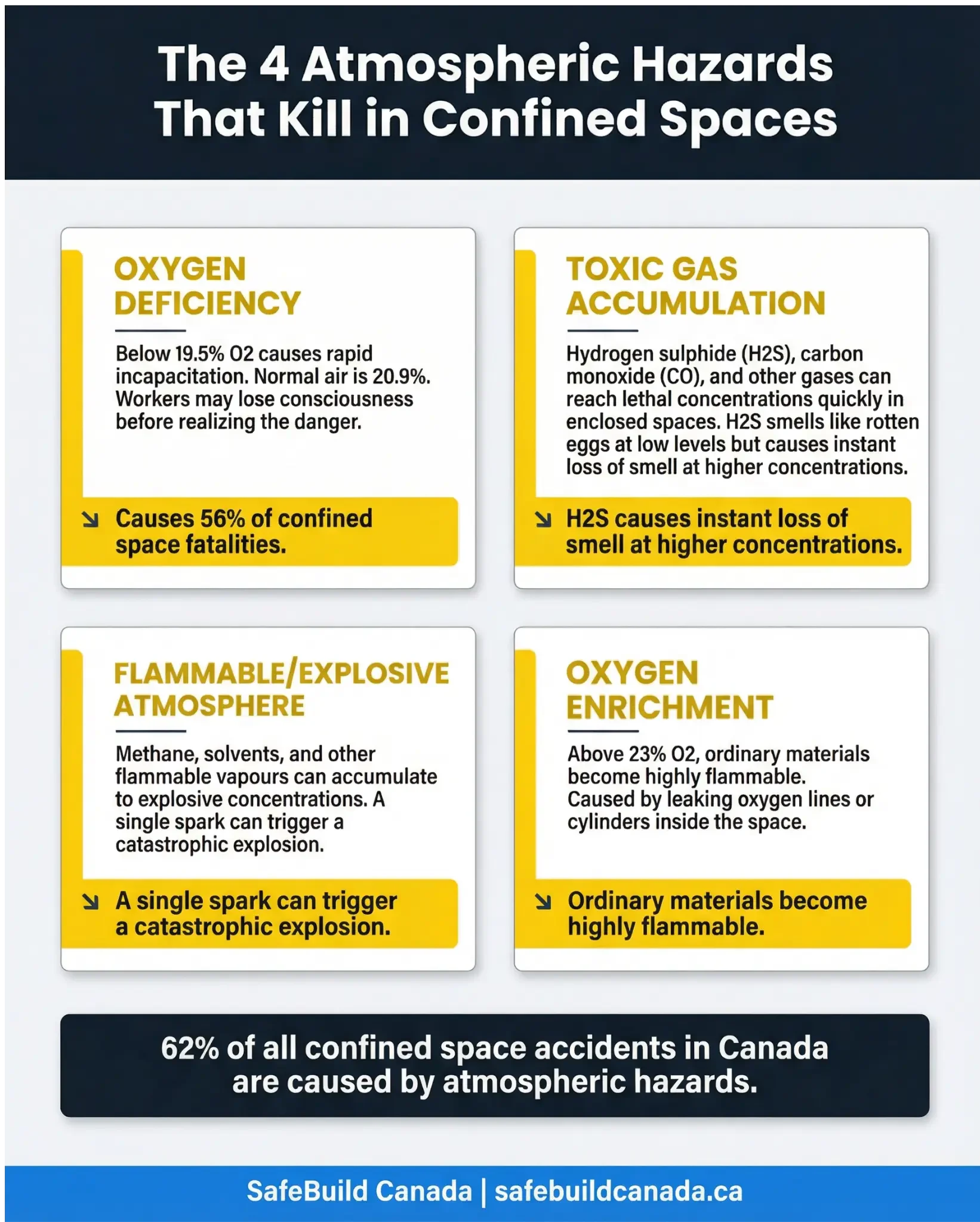
Every confined space entry in Canada requires at least one attendant stationed outside the space for the entire duration of the entry. The attendant's role is widely misunderstood. Many sites treat the attendant as a lookout or a formality. The law treats the attendant as the primary line of defense between a worker in distress and a fatality.
The attendant must understand the nature of the hazards in the specific space, recognize signs and symptoms that workers inside may experience, maintain constant two-way communication with entrants, monitor the confined space and the surrounding area continuously, do no other work that may interfere with their monitoring duties, order immediate evacuation if an uncontrolled hazard is detected, and call for emergency assistance immediately if an emergency develops.
The attendant must remain outside the confined space. This is not a suggestion. The attendant is not permitted to enter the space to assist a worker in distress. Their role is to initiate the rescue plan, not to become part of the problem. This is the rule that saves lives when it is followed and costs lives when it is not.
New Brunswick's regulation makes the minimum staffing requirement explicit: three people are required for any confined space entry. The entrant, an attendant at the entrance, and a backup employee within sight and shouting distance. Ontario describes the requirement as an adequate number of persons trained in on-site rescue procedures, first aid, CPR, and use of rescue equipment to be immediately available to begin on-site rescue.
The rescue plan: the piece most sites get wrong
The statistic that 60% of confined space deaths in Canada are would-be rescuers is not a coincidence. It reflects what happens when a site has an entry permit and an attendant but no rescue plan, or a rescue plan that amounts to "call 911 and wait." By the time emergency services arrive, the window for survival in an oxygen-deficient or toxic atmosphere is often already closed.
A proper confined space rescue plan must identify the type of rescue to be used (non-entry retrieval or entry rescue), the personnel responsible for rescue, the equipment to be used and its location, the emergency contact numbers for local emergency services, and the procedures for communicating with entrants and initiating rescue. The plan must be specific to each confined space, not a generic document that applies to all spaces on the site.
Non-entry rescue using a lifeline and retrieval system is the preferred method because it keeps the rescuer out of the hazardous atmosphere. This requires that entrants wear a full-body harness connected to a retrieval line whenever the geometry of the space permits. WorkSafeBC Part 9 sets out the specific requirements for lifelines, harnesses, and lifting equipment, including the requirement that the retrieval system be capable of lifting the entrant without causing additional injury.
If non-entry rescue is not possible, entry rescue may only be attempted by personnel who are fully trained in confined space rescue procedures and are wearing appropriate PPE including SCBA or a supplied-air respirator with an escape bottle. The rescue personnel must not use the same air as the workers they are rescuing. This is the rule that, when ignored, turns a single fatality into a multiple-fatality incident.
Training requirements across Canadian jurisdictions
Every worker who enters a confined space must be trained on hazard recognition, evaluation and control procedures, equipment setup and use (gas detectors, ventilation, lockout devices, PPE), communication and retrieval systems, safe work procedures, emergency procedures, and first aid and CPR.
Workers with rescue responsibilities require additional specialized training including hands-on practice with rescue equipment and regular drills. CCOHS recommends that employers keep records of all confined space training including refresher courses. The mandatory construction site training requirements in your province specify minimum training standards for confined space work, and those minimums should be treated as a floor, not a ceiling.
The training requirement is not satisfied by a one-time online course. Hands-on training with the actual equipment used on the specific site is the standard, and it is what WorkSafeBC and Ontario's Ministry of Labour look for when they investigate incidents.
Connecting confined space safety to your broader safety program
Confined space entry does not exist in isolation. The written confined space program should be a component of your broader site-specific safety plan, and the entry permit system should integrate with your lockout/tagout procedures, your hot work permit system, and your emergency response plan. If you are working toward COR certification, your confined space program will be reviewed as part of the audit, and gaps in the written program, the hazard assessment records, or the training documentation will affect your score.
The fall protection plan that governs work at height and the confined space entry program that governs work below grade are the two documents most likely to be requested by a provincial inspector on a Canadian construction site. Having both in order, current, and understood by your supervisors is the baseline expectation, not a bonus.
SOURCES
Canadian Centre for Occupational Health and Safety, Confined Space: Program, CCOHS, November 2022.
WorkSafeBC, OHS Regulation Part 9: Confined Spaces, WorkSafeBC, 2024.
Infrastructure Health and Safety Association, Confined Space Safety: Resources and Training, IHSA, 2024.
Canada Safety Training Centre, 10 Key Statistics of Confined Spaces Revealing Major Risks, Canada Safety Training Centre, 2024.
Government of Ontario, O.Reg. 632/05: Confined Spaces, ontario.ca, current to March 2026.
Canadian Centre for Occupational Health and Safety, Confined Space: Atmospheric Testing, CCOHS, 2024.