
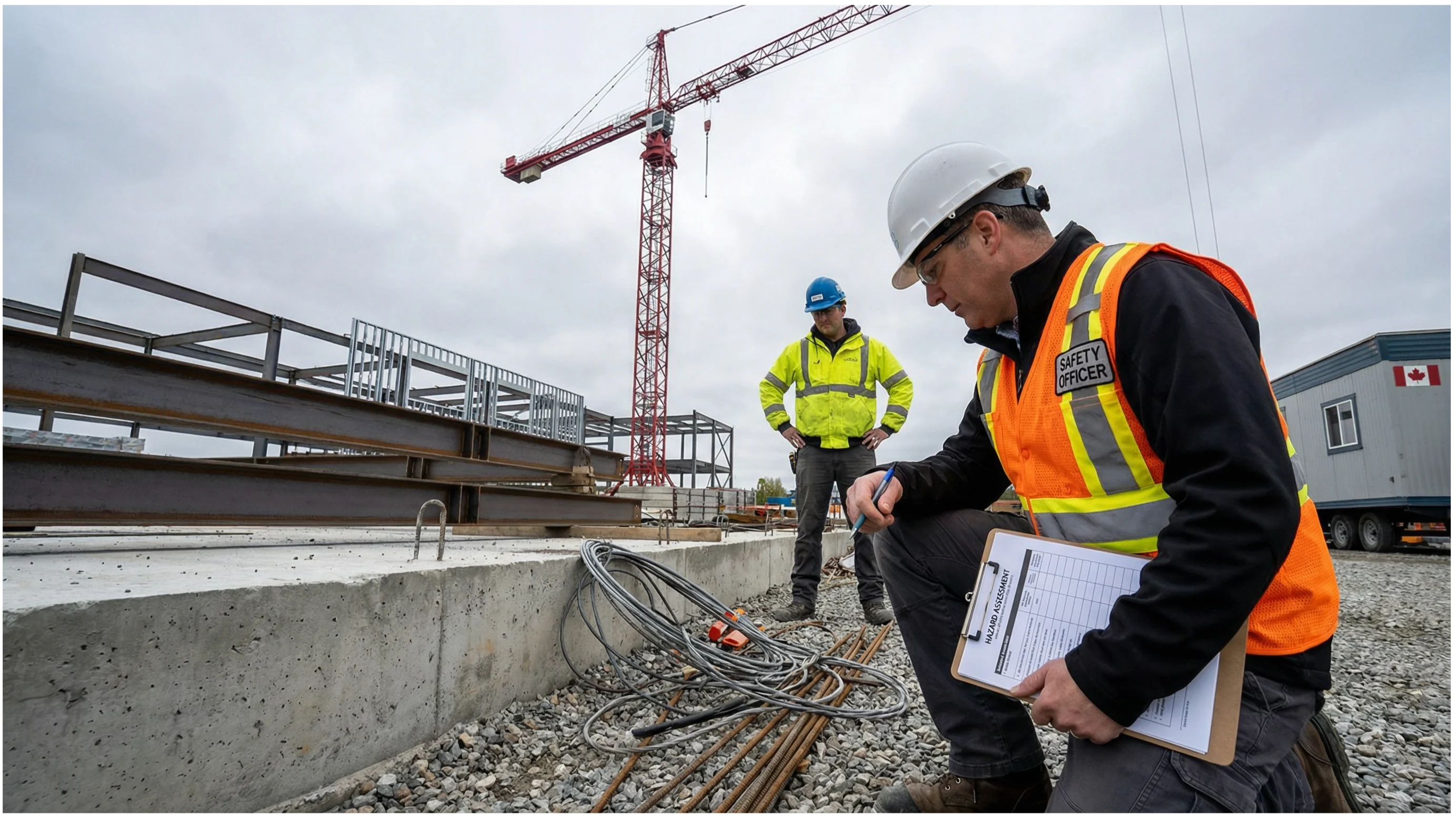
Hazard identification and risk assessment in Canadian construction: the complete guide
Every serious injury on a Canadian construction site begins the same way. A hazard exists, no one formally identifies it, and a worker encounters it before anyone has thought through what to do. That sequence is not inevitable. It is the result of a gap in the hazard assessment process, and it is preventable.
Canada reported more than 277,000 workplace injuries in 2022, according to the Association of Workers' Compensation Boards of Canada. Construction accounts for a disproportionate share of those numbers. Falls, struck-by incidents, and equipment-related injuries dominate the statistics, and the Ontario government notes that falls alone are the top cause of critical injuries and deaths on Ontario construction sites. The frustrating reality is that most of those incidents involve hazards that were present, visible, and assessable before anyone got hurt.
This guide explains how hazard identification and risk assessment actually work in Canadian construction, covering the three-tier assessment system used across the country, the risk rating process, the hierarchy of controls, and the province-specific requirements that determine what your site is legally obligated to do. It is the central resource in our hazard identification and risk assessment pillar, and it links out to our detailed posts on fall protection plans in Canada, confined space entry in Canadian construction, and construction site emergency response planning.
Why hazard assessment is a legal obligation, not just good practice
Every Canadian province and the federal government require employers to identify and assess workplace hazards before work begins. The specific language differs by jurisdiction, but the obligation is consistent. In British Columbia, WorkSafeBC's OHS Regulation Section 5.54 requires employers to identify existing and potential hazards before work begins, document the assessment in writing, and inform workers of the results. In Ontario, the Occupational Health and Safety Act requires employers to take every precaution reasonable in the circumstances for the protection of workers, and O. Reg. 213/91 (Construction Projects) spells out specific hazard control requirements for construction sites. In Alberta, the OHS Act requires a written hazard assessment before work begins, with workers involved in the process.
The CCOHS defines a hazard as a potential source of injury, adverse health effect, or damage to people, structures, equipment, or the environment. Risk, by contrast, is the combination of the probability that harm will occur and the severity of that harm if it does. The CCOHS expresses this simply: risk equals probability multiplied by severity. This distinction matters because not every hazard carries the same risk, and your assessment process needs to account for both dimensions, not just whether a hazard exists.
Failing to conduct a proper hazard assessment is not a procedural oversight. It is a regulatory violation that can result in stop-work orders, fines, and in cases where a fatality occurs, criminal liability under the Westray Bill amendments to the Criminal Code of Canada. If you are building your overall safety program from the ground up, our construction site safety guide covers how hazard assessment fits into the broader framework of a compliant OHS program.
The three-tier hazard assessment system
Canadian construction uses a layered approach to hazard assessment, with three distinct tools that serve different purposes and operate at different points in the work cycle. Understanding how they fit together is the key to building a system that actually catches hazards before they cause harm.
The 3-Tier Hazard Assessment System in Canadian Construction: Formal Hazard Assessment (broadest scope, before project begins), Job Hazard Analysis (task-specific, before each activity), Field Level Hazard Assessment (most frequent, right before starting work)
The 3-Tier Hazard Assessment System in Canadian Construction, showing the scope and frequency of each tier from the broadest Formal Hazard Assessment to the most immediate Field Level Hazard Assessment. SafeBuild Canada | safebuildcanada.ca
Formal Hazard Assessment (FHA)
The Formal Hazard Assessment is the broadest and most thorough of the three tiers. It is conducted before a project begins or before a new phase of work starts, and it is typically led by a safety officer, project manager, or senior supervisor. The FHA covers all anticipated hazards for the entire project scope, from site access and ground conditions to overhead work, equipment operation, and utility conflicts.
The FHA is the document that underpins your COR certification. When a COR auditor reviews your safety program, the FHA is one of the first things they look for, and it needs to be thorough, site-specific, and signed off by a competent person. A generic template with no site-specific content will not pass. The FHA also needs to be reviewed and updated when conditions change, when new phases begin, or when new hazards are identified.
Job Hazard Analysis (JHA) or Job Safety Analysis (JSA)
The Job Hazard Analysis sits in the middle tier. It is a task-specific document prepared before a particular job or activity begins, and it is typically developed by a supervisor or safety planner in consultation with the workers who will do the work. A JHA breaks the task down into discrete steps, identifies the hazards at each step, and documents the control measures that will be used.
A JHA for a concrete pour, for example, would walk through formwork inspection, pump setup, placement, vibration, and finishing, identifying the hazards at each stage and specifying whether the control is a guardrail, a safe work procedure, PPE, or some combination. The JHA becomes a standing document that workers review before starting the task and that supervisors use to verify controls are in place.
Field Level Hazard Assessment (FLHA)
The FLHA is the most immediate and most frequently used tool in the system. It is a quick, task-specific check conducted by frontline workers right before they start a job. Unlike the FHA and JHA, which are prepared in advance by supervisors and safety professionals, the FLHA is the worker's own real-time assessment of the conditions they are about to work in.
The Infrastructure Health and Safety Association (IHSA) describes hazard assessment as a tool that helps workers stop, look around, and identify anything that might pose a danger in the current moment. A JHA might have been written three weeks ago. The FLHA catches what has changed since then: the ground is now frozen and slippery, a new crew is working overhead, the wind has picked up, or a piece of equipment has been repositioned into the work zone.
FLHAs are required in Alberta and are a standard expectation on most COR-certified construction sites across Canada. They are typically a short checklist form, either paper or completed on a safety app, and they take five to ten minutes to complete. The FLHA does not replace the JHA or the FHA. It works alongside them as the last line
How to rate hazard risk
Once hazards are identified, they need to be rated so you can prioritize which ones require immediate action and which can be scheduled for correction. The standard Canadian approach uses a likelihood-times-severity matrix.
Likelihood is rated on a scale from rare (1) to almost certain (5). Severity is rated from negligible (1) to catastrophic (5). Multiplying the two scores produces a risk rating. Scores from 1 to 6 are considered low risk, requiring monitoring but no immediate action. Scores from 7 to 12 are medium risk, requiring control measures to be implemented and scheduled. Scores from 13 to 19 are high risk, requiring immediate corrective action. Scores from 20 to 25 are critical, requiring a stop-work order until the hazard is controlled.
The risk rating matrix is not a bureaucratic exercise. It is a decision-making tool. When you have ten hazards identified on a site and limited time and resources, the matrix tells you which three to address today and which seven can wait until next week. Without it, you are making those decisions based on gut feel, which is how the minor-seeming hazard gets ignored until someone gets hurt.
Applying the hierarchy of controls
Identifying and rating a hazard is only half the job. The other half is selecting the right control. The CCOHS hierarchy of controls provides a ranked framework for doing this, from the most effective controls to the least effective.
Hierarchy of Controls for Canadian Construction Sites: Elimination (most effective), Substitution, Engineering Controls, Administrative Controls, PPE (least effective)
The Hierarchy of Controls for Canadian Construction Sites, ranked from the most effective (elimination) to the least effective (PPE). SafeBuild Canada | safebuildcanada.ca
Elimination sits at the top of the hierarchy and is the most effective control because it removes the hazard entirely. On a construction site, this might mean redesigning a task, so it does not require working at height, or scheduling deliveries to eliminate the need for workers to be in a vehicle movement zone. Elimination is not always possible, but it should always be the first question you ask.
Substitution replaces a hazardous material or process with a less hazardous one. Switching from solvent-based to water-based coatings or using a larger granule form of a product instead of a fine powder to reduce dust, are both substitution controls. Like elimination, substitution removes or reduces the hazard at the source rather than managing exposure to it.
Engineering controls manage the hazard at the source without relying on worker behavior. Guardrails, machine guards, ventilation systems, and safety nets are all engineering controls. They are more reliable than administrative controls or PPE because they do not depend on workers remembering to do something or wearing something correctly every single time.
Administrative controls change how work is done through procedures, training, scheduling, and supervision. Rotating workers out of high-noise areas, implementing a permit-to-work system for confined space entry, or requiring a pre-task safety meeting before high-risk work are all administrative controls. They are useful but they have a fundamental limitation: they rely on human behavior, which is inconsistent.
PPE sits at the bottom of the hierarchy and is the last line of defense, not the first. Hard hats, harnesses, gloves, respirators, and hearing protection all have an important role on a construction site, but they do not eliminate the hazard. They reduce the severity of harm if something goes wrong. Relying on PPE as the primary control for a high-risk hazard is a regulatory and ethical failure. The CCOHS is explicit on this point: PPE should be used in combination with other control measures, not instead of them.
Province-specific requirements you need to know
While the three-tier system and the hierarchy of controls apply nationally, the specific legal requirements for hazard assessment vary by province.
In Ontario, the OHSA requires employers to provide information, instruction, and supervision to protect workers, and O. Reg. 213/91 sets out specific hazard control requirements for construction projects. The Ontario government's guidance on hazards in the construction sector identifies five main hazard categories: falls, struck-by incidents, heavy equipment operation, ergonomics, and occupational illness and disease. Working at heights training has been mandatory since 2015 for workers using fall protection systems on Ontario construction projects.
In British Columbia, WorkSafeBC's OHS Regulation requires a written hazard assessment before work begins, with workers informed of the results and the assessment reviewed whenever conditions change. BC's regulation is notable for its requirement that workers be involved in the hazard assessment process, not just informed of the results after the fact.
In Alberta, the OHS Act requires a formal hazard assessment in writing before work begins, and the FLHA is a standard expectation on all regulated construction sites. Alberta's COR program, administered by the Alberta Construction Safety Association, places heavy weight on the hazard assessment program during audits.
At the federal level, the Canada Labour Code Part II requires employers in federally regulated industries to identify and assess hazards before work begins, with workers involved in the process. Federally regulated construction projects, including those on federal lands and in transportation infrastructure, must meet these requirements in addition to any applicable provincial standards.
Hazard assessment and your COR certification
If your organization is working toward or maintaining COR certification, the hazard assessment program is one of the most heavily weighted elements in the audit. COR auditors across Canada look for evidence that hazard assessments are conducted consistently, that workers are involved in the process, that controls are selected using the hierarchy, and that the assessments are reviewed and updated when conditions change.
A stack of blank FLHA forms in the site trailer does not constitute a hazard assessment program. Auditors want to see completed forms, dated and signed, with site-specific hazards identified and controls documented. They want to see JHAs that are task-specific and not just copied from a generic template. They want to see FHAs that reflect the actual scope and conditions of the project.
The documentation trail matters as much as the process itself. If your workers are doing good hazard assessments but not recording them, you will not get credit for it in a COR audit, and you will have no defense if a regulator investigates an incident.
Connecting hazard assessment to your broader safety program
Hazard assessment does not exist in isolation. It is the foundation that every other element of your safety program is built on. Your fall protection plan in Canada references the hazards identified in your FHA. Your confined space entry program is triggered by hazards identified during site assessment. Your construction site inspection program verifies that the controls selected through hazard assessment are actually in place and working.
If you are building your safety plan from scratch, our guide to building a construction site safety plan in Canada covers how the hazard assessment program connects to your written OHS program, including the documentation requirements and the sections that COR auditors review most closely. For high-risk work environments, our post on confined space entry in Canadian construction explains how the hazard assessment process applies in one of construction's most dangerous environments.
The practical starting point is to build the three-tier system into your site startup process. The FHA gets completed before mobilization. JHAs are developed for each major work activity before that activity begins. FLHAs become a daily habit for every crew, supported by a simple form and a supervisor who asks to see them. That structure does not require a large safety department or a sophisticated software platform. It requires discipline and a genuine belief that identifying hazards before work begins is worth the time it takes.
What to do when you find a hazard you cannot immediately control
Not every hazard can be eliminated or controlled on the spot. When a hazard is identified but cannot be immediately addressed, the standard Canadian approach requires three things: document the hazard, implement interim controls, and schedule corrective action with a specific deadline and responsible person named.
Interim controls are temporary measures that reduce risk while a permanent solution is arranged. If a guardrail cannot be installed today because the materials have not arrived, interim controls might include a temporary barricade, a spotter, and a restricted work zone. These controls need to be documented in the hazard assessment record, along with the date the permanent control is expected to be in place.
Workers must be informed of identified hazards and the controls in place, even when those controls are temporary. This is a legal requirement in every Canadian jurisdiction. A worker who enters a hazardous area without being told about the hazard and the interim control in place is not protected by the fact that the hazard was identified. The information must reach the worker before they start the work.
Building a hazard assessment culture on your site
The most effective hazard assessment programs are not the ones with the most sophisticated forms or the most detailed templates. They are the ones where workers believe that identifying hazards matters and where supervisors create the conditions for honest reporting.
That means supervisors who respond to hazard reports with action, not dismissal. It means workers who are not penalized for stopping work when they identify a hazard they cannot control. It means FLHAs that are completed thoughtfully rather than signed off in thirty seconds to satisfy a requirement. And it means a site culture where the question "what could go wrong here?" is asked before every task, not after someone gets hurt.
Building that culture starts with the people at the top of the site hierarchy. When project managers and superintendents take hazard assessment seriously, workers follow. When they treat it as paperwork, workers do the same.
Documenting hazard assessments for regulatory compliance
Documentation is not optional in Canadian construction. Every province requires that hazard assessments be recorded in writing, retained for a specified period, and made available to workers and inspectors on request. In British Columbia, WorkSafeBC can request hazard assessment records during a site inspection, and the absence of documentation is treated as evidence that no assessment was conducted. In Ontario, the Ministry of Labour can issue orders requiring employers to produce written hazard assessment records, and failure to comply can result in fines under the OHSA.
The format of the documentation matters less than its completeness. Whether you use a paper form, a safety app, or a spreadsheet, the record needs to capture the date, the location, the hazards identified, the risk rating for each hazard, the controls selected, and the name of the competent person who conducted the assessment. For FLHAs, the worker's signature is required. For JHAs and FHAs, the supervisor or safety officer responsible for the assessment must sign off.
Retention periods vary by province. In Alberta, hazard assessment records must be retained for as long as the hazard exists and for a period after the work is complete. In Ontario, records related to a workplace injury must be retained for at least three years. Best practice is to retain all hazard assessment records for a minimum of three years, regardless of jurisdiction, and to store them in a way that makes them retrievable if a regulator or insurer requests them.
Equipping your team for hazard control
When your hazard assessment identifies a risk that cannot be eliminated or engineered out, you must rely on PPE as your last line of defense. Ensuring your workers have the right gear is critical. For example, if your FHA identifies overhead hazards, you need to ensure every worker is equipped with a compliant hard hat. You can review our guide on Type 1 vs. Type 2 hard hats in Canada to understand which option is required for your specific site conditions.
When to bring in a safety consultant
Building a comprehensive three-tier hazard assessment system from scratch is a massive undertaking. If your company is preparing for its first COR audit, or if you have recently experienced a serious incident that revealed gaps in your FHA process, it is often more effective to bring in external expertise. A qualified Canadian safety consultant can help you build site-specific FHA templates, train your supervisors on conducting effective JHAs, and implement a digital FLHA system that your workers will use.
Download your Canadian-compliant FLHA template
A blank piece of paper is not an effective hazard assessment tool. To help your frontline workers conduct thorough, consistent FLHAs every day, we have developed a free, Canadian-compliant FLHA template. It includes the standard risk rating matrix and prompts for the most common construction hazards. Download the template today and start building a stronger hazard assessment culture on your site tomorrow.
Sources
Ontario Ministry of Labour, Immigration Training and Skills Development: Hazards in the construction sector 2024
Canadian Centre for Occupational Health and Safety Hazard and Risk: Hierarchy of Controls 2024
Infrastructure Health and Safety Association: Workplace Hazard Assessment and Control 2024
Canadian Centre for Occupational Health and Safety, Hazard and Risk: Risk Assessment 2024
WorkSafeBC: OHS Regulation Part 5, Section 5.54 Hazard Identification, 2024