
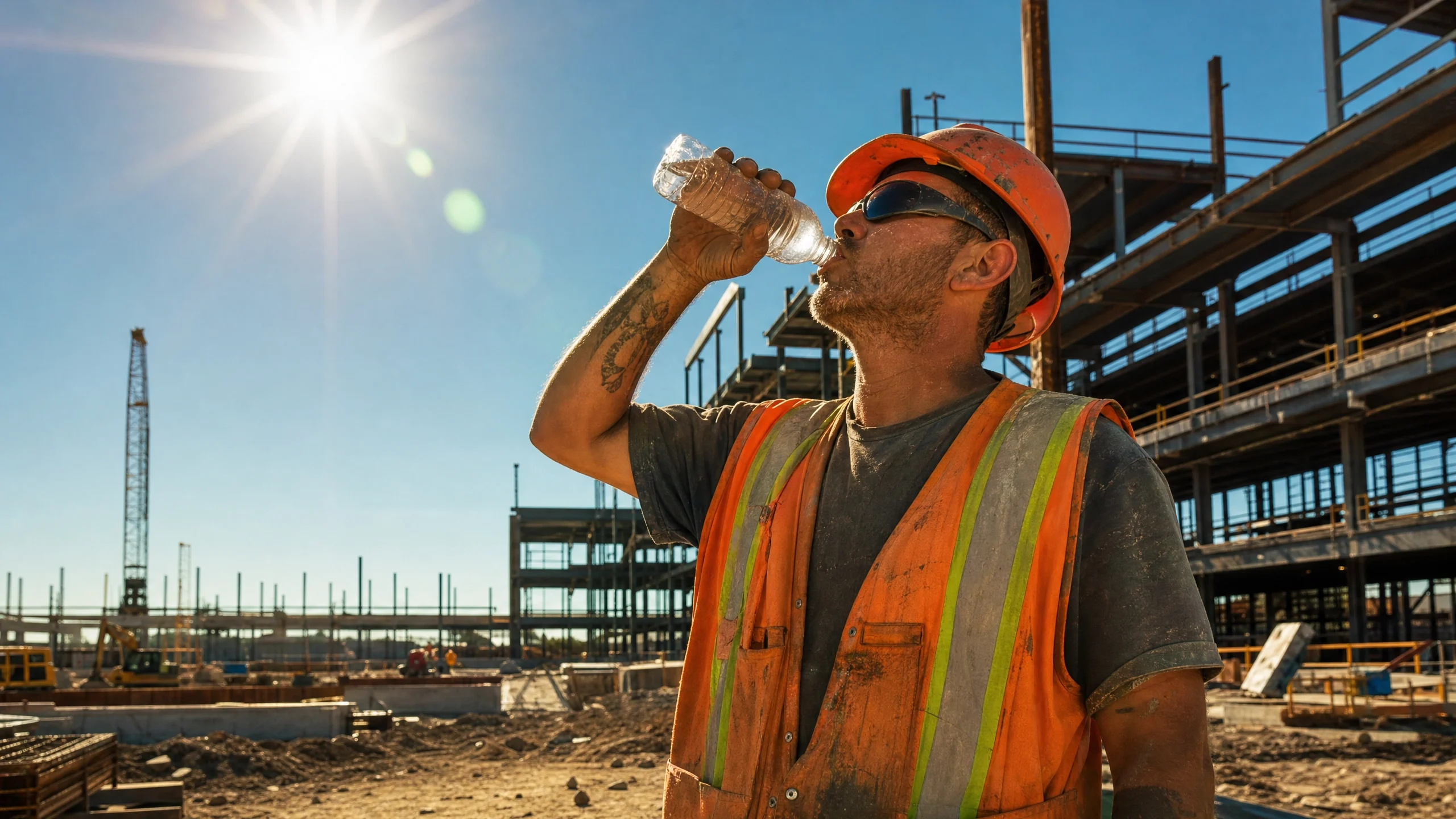
Summer construction in Canada brings intense physical demands under punishing weather conditions. When the humidex climbs above 30, the risk of heat related illness skyrockets for workers performing heavy manual labour outdoors. Heat stress is not just a comfort issue; it is a critical occupational hazard that can rapidly progress from mild cramps to fatal heat stroke if left unmanaged.
Canadian occupational health and safety legislation places the burden squarely on employers to protect workers from thermal stress. While specific temperature thresholds vary by province, the general duty clause across all jurisdictions requires employers to take every reasonable precaution to maintain a safe work environment. This means having a proactive, written heat stress prevention plan before the first heat wave hits.
This guide breaks down exactly what Canadian construction employers must do to manage heat stress, how to recognize the warning signs of heat illness, and how to implement effective controls like acclimatization schedules and humidex based work rest cycles.
Understanding heat stress and the humidex
Heat stress occurs when the body cannot cool itself fast enough to maintain a healthy internal temperature. Construction workers are particularly vulnerable because they perform strenuous physical labour, often in direct sunlight, while wearing heavy personal protective equipment.
In Canada, the humidex is the standard measurement used to assess heat stress risk. The humidex combines air temperature and relative humidity to indicate how hot the weather actually feels to the human body. Because high humidity prevents sweat from evaporating efficiently, a day that is 30 degrees Celsius with high humidity can feel like 40 degrees, drastically increasing the physical strain on workers.
The Canadian Centre for Occupational Health and Safety provides clear guidance on humidex action levels. When the humidex is below 29, there is generally little discomfort. Between 30 and 39, workers will experience some discomfort, and employers should begin monitoring conditions and increasing hydration breaks. When the humidex reaches 40 to 45, the situation becomes dangerous, requiring reduced workloads and mandatory rest breaks. Above 45, the risk is extreme, and non essential outdoor work should be stopped.
The progression of heat illness
Heat illness is not a single condition but a spectrum of disorders that escalate in severity. Employers and supervisors must train their crews to recognize the early warning signs, as workers suffering from heat stress often become confused and may not realize they are in danger.
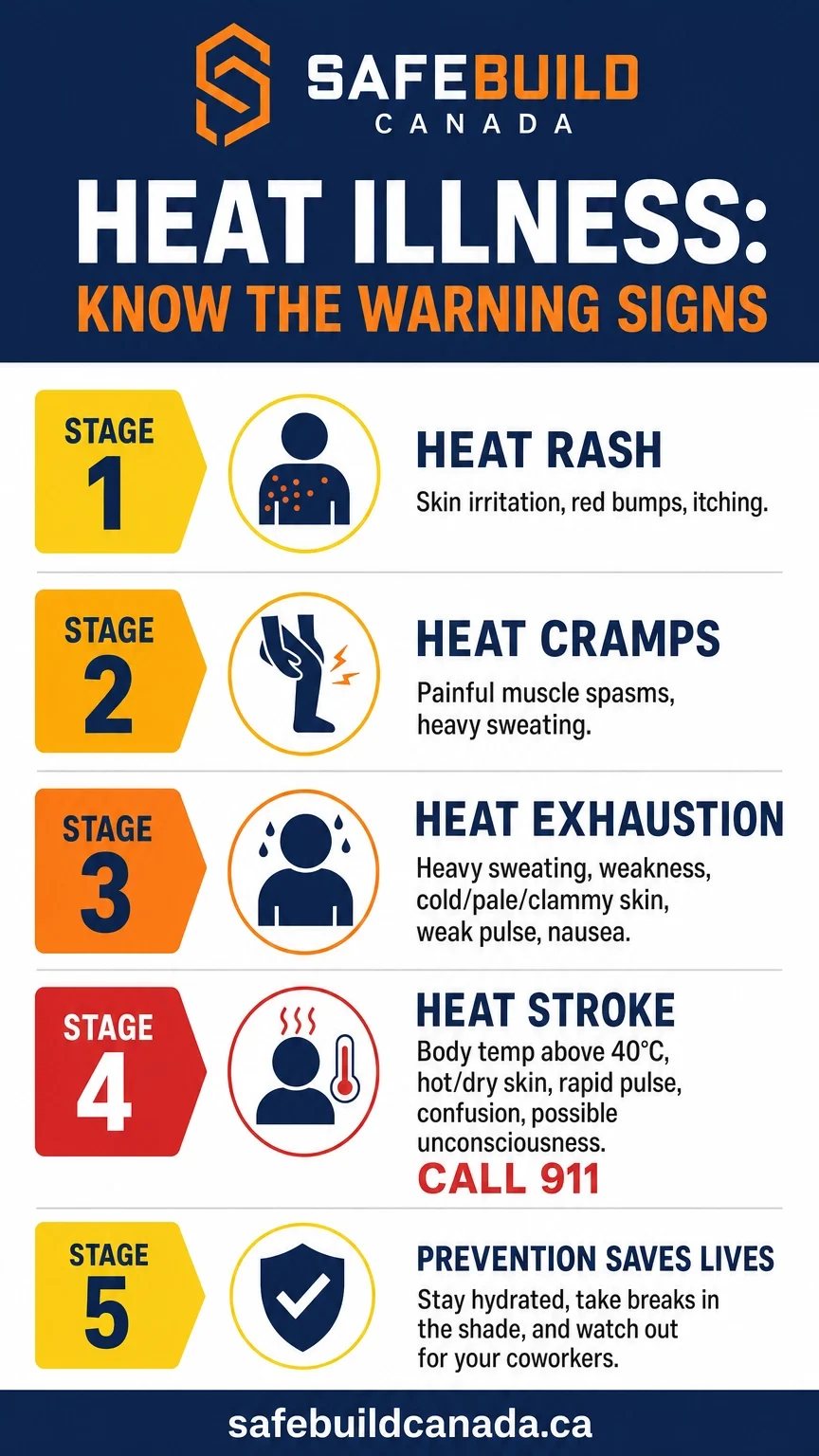
Stage 1: Heat rash and heat cramps
The earliest signs of heat stress are often physical discomforts that workers might try to push through. Heat rash appears as red, itchy bumps on the skin where sweat cannot evaporate, often under tight clothing or protective gear. Heat cramps are painful muscle spasms, typically in the legs or abdomen, caused by the loss of salt and fluids through heavy sweating. Workers experiencing cramps should stop heavy lifting, move to a shaded area, and drink water or electrolyte replacement fluids.
Stage 2: Heat exhaustion
If early signs are ignored, the body's cooling system begins to fail, leading to heat exhaustion. Symptoms include heavy sweating, extreme weakness, dizziness, nausea, and cold, pale, or clammy skin. The worker's pulse may become fast and weak. Heat exhaustion requires immediate intervention. The worker must be moved to a cool environment, given water, and monitored closely. If symptoms do not improve within an hour, medical attention is necessary.
Stage 3: Heat stroke
Heat stroke is a life threatening medical emergency. It occurs when the body's temperature regulation completely breaks down, and core temperature soars above 40 degrees Celsius. Symptoms include hot, red, and dry skin (sweating may have stopped entirely), a rapid and strong pulse, confusion, disorientation, slurred speech, and possible unconsciousness. If you suspect a worker has heat stroke, call 911 immediately. While waiting for emergency responders, move the worker to the shade and aggressively cool them with cold water, ice packs, or wet towels.
Employer legal obligations across Canada
While the specific wording of occupational health and safety regulations varies by province, the core requirement remains consistent: employers must protect workers from hazardous thermal conditions.
In Ontario, the Occupational Health and Safety Act requires employers to take every reasonable precaution in the circumstances for the protection of a worker. The Infrastructure Health and Safety Association notes that this duty includes protecting workers from heat stress. Furthermore, Ontario Regulation 213/91 specifically mandates that employers provide access to clean drinking water on construction projects.
In British Columbia, the WorkSafeBC Occupational Health and Safety Regulation explicitly covers thermal conditions. Employers are required to conduct a heat stress assessment and implement an exposure control plan if workers are at risk.
In Alberta, the Occupational Health and Safety Act general duty clause applies. While there is no specific temperature threshold written into the code, employers are expected to follow recognized industry standards, such as the guidelines provided by the Canadian Centre for Occupational Health and Safety, to manage the hazard.
Regardless of the province, relying on common sense is not enough to meet legal due diligence requirements. Employers must have a formal, documented approach to heat stress management.
Building an effective heat stress prevention plan
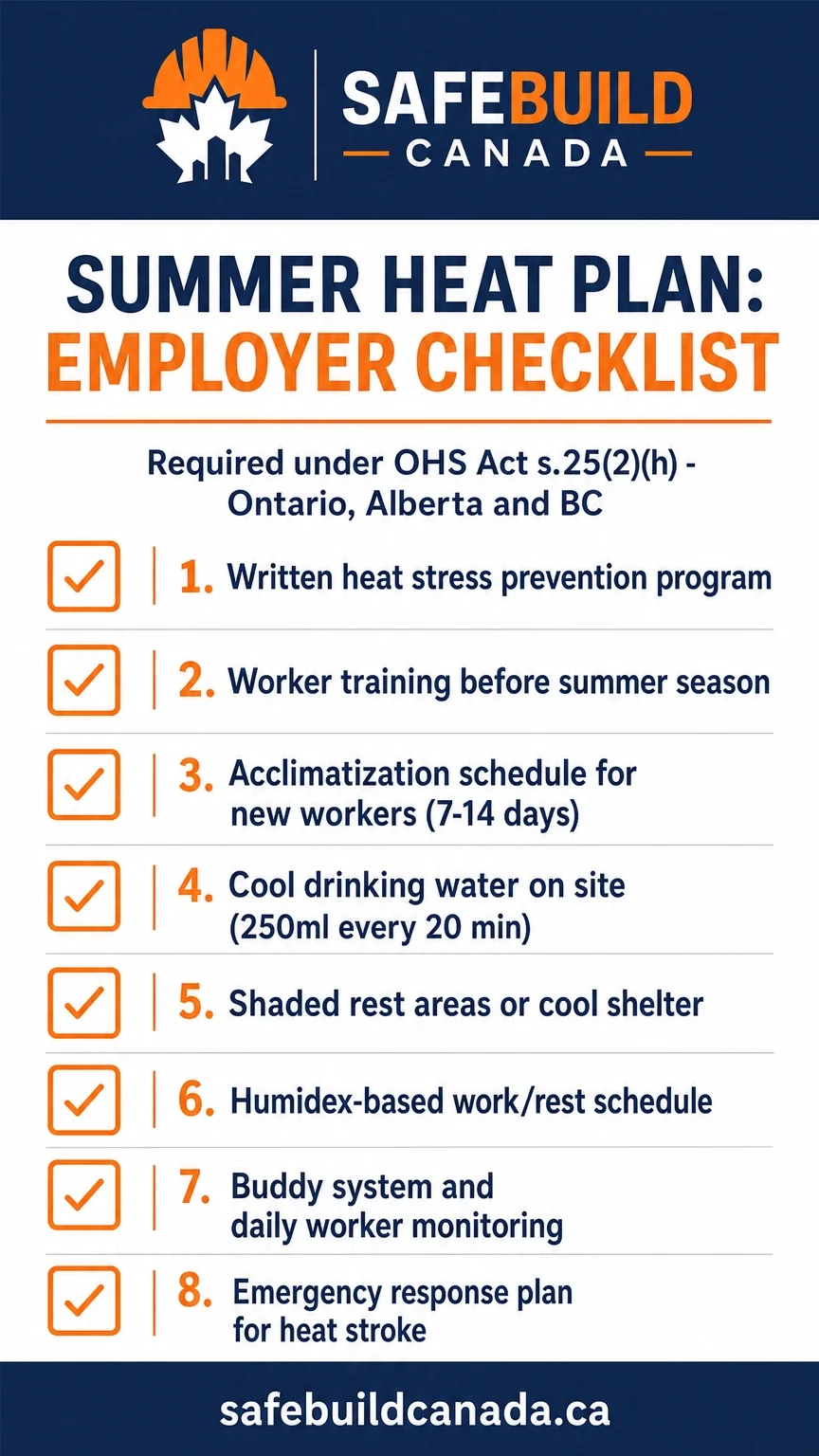
A robust heat stress prevention plan requires proactive planning and daily execution. It belongs in your overall construction site safety guide alongside fall protection and hazardous energy control.
1. Implement an acclimatization schedule
Acclimatization is the physiological process where the body adapts to working in hot environments. It takes time for the body to learn to sweat more efficiently and regulate its core temperature. Employers cannot expect a new hire, or a worker returning from a two week vacation, to immediately perform heavy labour in 35 degree heat.
A standard acclimatization schedule gradually increases the worker's exposure to the heat over seven to fourteen days. On the first day, the worker should only perform 20 percent of their normal workload in the hot environment. This should increase by 20 percent each subsequent day. During this period, supervisors must monitor the worker closely for signs of distress.
2. Establish humidex based work and rest cycles
When the temperature spikes, the standard break schedule is no longer sufficient. Employers must implement dynamic work and rest cycles based on the daily humidex reading and the physical intensity of the tasks being performed.
The Occupational Health Clinics for Ontario Workers provides a widely used humidex based response plan. As the humidex rises, the required rest time per hour increases. For example, moderate work at a humidex of 36 might require 15 minutes of rest per hour, while the same work at a humidex of 40 might require 45 minutes of rest per hour. These rest breaks must be taken in a shaded, cool area to allow the body to recover.
3. Mandate hydration protocols
Thirst is a poor indicator of hydration status; by the time a worker feels thirsty, they are already dehydrated. Employers must provide easy access to cool, potable drinking water close to the work area. Workers should be instructed to drink approximately 250 millilitres (one cup) of water every 20 minutes, rather than chugging large amounts infrequently.
Avoid providing caffeinated beverages or energy drinks with high sugar content, as these can contribute to dehydration. For highly strenuous tasks lasting several hours, electrolyte replacement drinks may be beneficial, but water should remain the primary hydration source.
4. Modify work schedules and practices
One of the most effective ways to manage heat stress is to eliminate the hazard through scheduling. Whenever possible, schedule the most physically demanding tasks, such as heavy concrete pouring or manual excavation, for the early morning hours before the sun reaches its peak intensity.
If work must be done during the hottest part of the day, rotate workers through strenuous tasks to limit individual exposure. Consider using mechanical aids to reduce the physical exertion required. Any hazard identification and risk assessment conducted during the summer months must explicitly account for thermal stress.
5. Enforce the buddy system
Because heat stroke can cause confusion and impaired judgment, workers may not recognize their own symptoms. Implement a strict buddy system where workers are paired up and responsible for monitoring each other for signs of heat illness. Supervisors must also conduct frequent check ins, especially for workers performing isolated tasks.
6. Prepare for heat emergencies
Despite all preventive measures, heat emergencies can still occur. Your site's construction site emergency response plan must include specific protocols for handling heat exhaustion and heat stroke.
First aid attendants must be trained to recognize and treat heat illness. Keep emergency cooling supplies, such as ice packs and cold water, readily available. Most importantly, all workers must know the exact site address and access points to direct emergency medical services without delay.
The role of personal protective equipment
Personal protective equipment is essential for construction safety, but it can significantly exacerbate heat stress by trapping body heat and preventing sweat evaporation. When selecting gear, employers must balance the need for impact and hazard protection with thermal comfort.
All gear must meet CSA PPE standards, and employers should look for breathable, lightweight options where permitted. For example, vented hard hats and moisture wicking high visibility apparel can improve airflow. However, workers must never remove mandatory safety gear, such as fall harnesses or safety glasses, simply because they are hot. If the required PPE makes the work too hot to perform safely, the employer must increase rest breaks or modify the work schedule to compensate.
Enforcement and compliance
Provincial occupational health and safety inspectors actively target heat stress compliance during the summer months. During an OHS inspection, an inspector will ask to see your written heat stress policy, verify that workers have access to water and shade, and check that supervisors are actively monitoring the humidex and adjusting work schedules accordingly.
Failing to protect workers from heat stress can result in stop work orders, significant fines, and, in the event of a severe injury or fatality, criminal prosecution under the Westray Bill provisions of the Criminal Code.
Protecting your crew from the summer heat is not just about regulatory compliance; it is about ensuring that the men and women building our infrastructure go home safely at the end of every shift. By implementing a proactive heat stress management plan, providing adequate hydration and rest, and training your team to recognize the warning signs, you can maintain productivity while keeping your workforce safe during the hottest months of the year.