
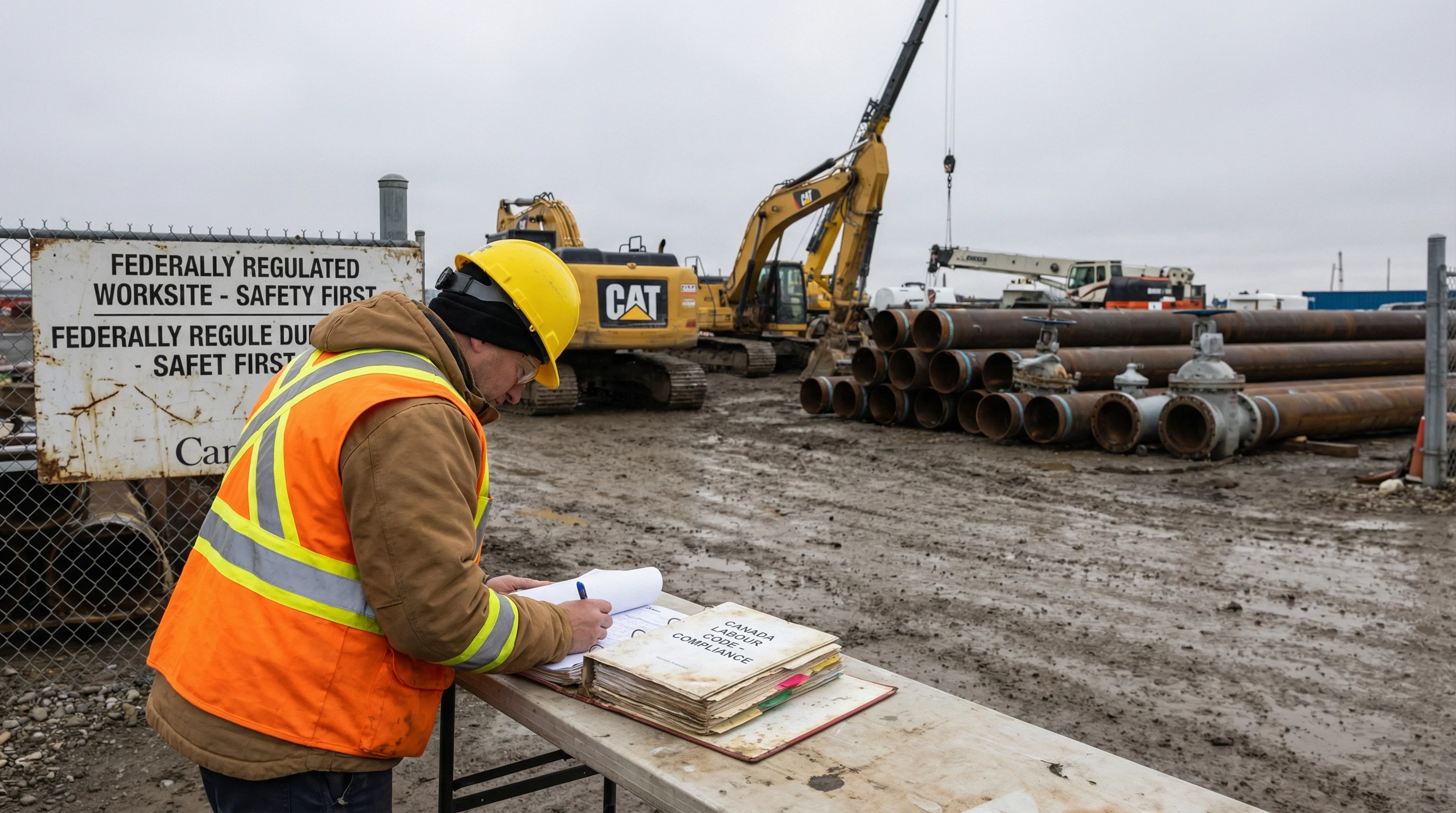
Most construction employers in Canada operate under provincial OHS legislation. Ontario's OHSA, BC's Workers Compensation Act, Alberta's OHS Act: these are the frameworks that govern the vast majority of construction sites. But a significant slice of the industry works under a different set of rules entirely, and many employers in that slice do not fully understand what those rules require.
Part II of the Canada Labour Code is the federal occupational health and safety statute. It applies to federally regulated industries, and it comes with its own employer duties, worker rights, committee requirements, and incident reporting obligations. If your work falls under federal jurisdiction and you are treating your OHS obligations as if they were governed by your province, you are operating on a flawed assumption that could cost you significantly.
This post breaks down what Part II actually requires, who it applies to, and what your practical obligations are as a federally regulated employer.
Who does Canada Labour Code Part II actually cover
The first question most employers ask is whether Part II applies to them at all. The answer depends entirely on the nature of the work, not the location.
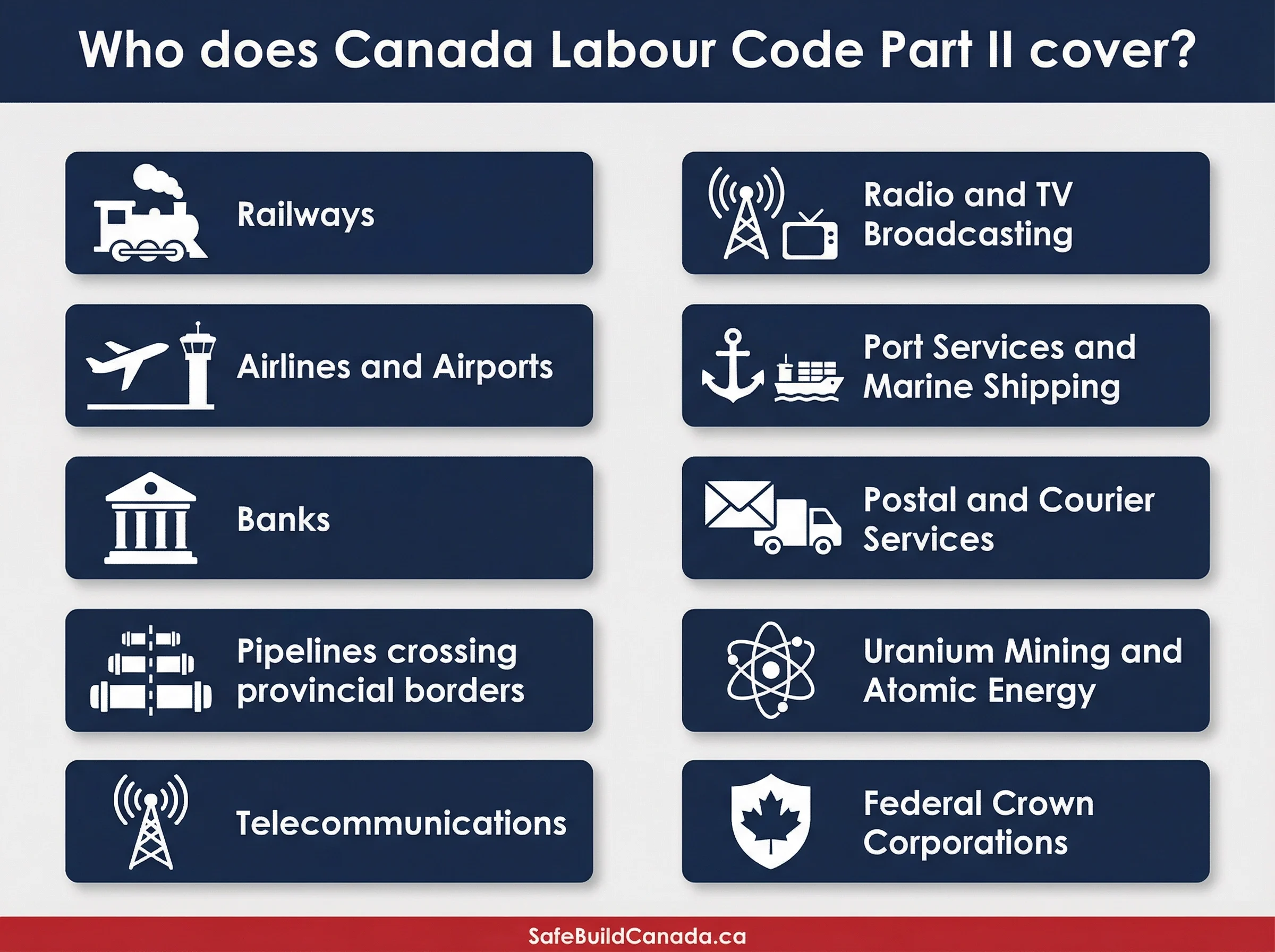
Part II applies to federally regulated industries. According to the Government of Canada's list of federally regulated industries and workplaces, these include air transportation (airlines, airports, aerodromes), banks and authorized foreign banks, railways that cross provincial or international borders, road transportation services that cross provincial or international borders, telecommunications systems (telephone, internet, cable), radio and television broadcasting, port services and marine shipping, pipelines that cross provincial or international borders, postal and courier services, uranium mining and atomic energy, and most federal Crown corporations.
The federal public service is also covered under Part II, though only for OHS purposes, not for the full range of labour standards in Parts I and III.
The practical implication for construction is this: if your company is building, maintaining, or modifying infrastructure that falls within federal jurisdiction, your workers on that project may be federally regulated. A crew installing telecommunications cable that crosses provincial borders, workers on a federally regulated pipeline project, or labourers at a federally regulated port facility are all potentially subject to Part II, not to the provincial OHS legislation that governs most of your other work.
The test is not where the work is performed. It is whether the work is integral to a federally regulated undertaking. That distinction matters, and it is worth confirming with legal counsel if you are unsure.
The three rights of workers under Part II
Part II of the Canada Labour Code gives every worker in a federally regulated workplace three fundamental rights. These are the same three rights that appear in provincial OHS legislation across Canada, but the federal versions have their own specific procedures and thresholds.
The right to know means workers are entitled to be informed of known or foreseeable hazards in the workplace. Employers must provide the information, instruction, training, and supervision necessary to protect health and safety. This right extends to workers with special needs, who must receive safety information in a format they can actually use, whether that is braille, large print, audio, sign language, or verbal communication.
The right to participate means workers can take part in identifying and correcting health and safety problems through workplace health and safety committees or health and safety representatives. This is not a passive right. Workers on committees have access to government and employer reports relating to health and safety, and they participate directly in investigations.
The right to refuse dangerous work means a worker can refuse to perform a task if they have reasonable cause to believe it presents a danger to themselves or a co-worker. The procedure for exercising this right under the Canada Labour Code is specific: the worker must report the refusal to their supervisor, the matter must be investigated, and if not resolved, it escalates to a Labour Program health and safety officer. A worker who follows the proper procedure cannot be disciplined for refusing dangerous work.
For federally regulated construction employers, the right to refuse is particularly relevant on projects where conditions change rapidly. A worker who believes a trench is unstable, a scaffold is improperly erected, or a confined space has not been properly assessed has the right to stop work and trigger the investigation process. Understanding how that process works, and training supervisors to handle it correctly, is a basic compliance requirement.
Employer duties under sections 124 and 125
The core employer obligations under Part II sit in sections 124 and 125 of the Canada Labour Code.
Section 124 is the general duty clause. It states that every employer shall ensure that the health and safety at work of every person employed by the employer is protected. This is a broad, non-delegable duty. It cannot be contracted away, and it applies regardless of what a subcontract or service agreement says about safety responsibilities.
Section 125 sets out specific duties that apply in every workplace controlled by the employer. These include providing and maintaining safe equipment, tools, machinery, and structures; ensuring that the use, handling, storage, and disposal of hazardous substances is done safely; providing workers with the information, instruction, training, and supervision necessary to do their work safely; investigating all hazardous occurrences; and posting required notices in the workplace.
The Government of Canada's summary of Part II describes the employer's obligation as one of prevention first: eliminate hazards where possible, reduce them where elimination is not feasible, and provide personal protective equipment only as a last resort. This hierarchy of controls is built into the statute at section 122.2.
For employers managing mandatory construction site training in Canada, the training obligations under section 125 are not optional extras. They are statutory requirements. Workers must receive the information and instruction they need to perform their specific tasks safely, and that training must be appropriate for the work being done.
Workplace health and safety committees: the thresholds that matter
One of the most commonly misunderstood requirements under Part II is the workplace health and safety committee (WPHSC) structure. The thresholds are different from most provincial requirements, and the three-tier structure is unique to the federal system.
Work place health and safety committees are required in any workplace with 20 or more employees. At least half of the committee members must be employees who do not hold managerial functions. The committee's role is to identify hazards, participate in investigations, and recommend corrective measures.
In workplaces with 19 or fewer employees, a health and safety representative must be appointed instead. The representative performs similar functions to a committee but operates individually rather than as a group.
Policy health and safety committees are required where an employer has 300 or more employees. The policy committee operates at the organizational level, addressing systemic issues that go beyond a single worksite. Its purpose is strategic: identifying patterns across the organization, reviewing policies, and making recommendations to senior management.
For a federally regulated construction employer with multiple active projects, this means you may need both a policy committee at the corporate level and work place committees at individual project sites, depending on crew sizes. The committees are not interchangeable, and the obligations attached to each are distinct.
Hazardous occurrence reporting: the timelines you cannot miss
The hazardous occurrence reporting requirements under Part II and the Canada Occupational Health and Safety Regulations (COHSR, SOR/86-304) are among the most operationally demanding aspects of federal OHS compliance. The ESDC hazardous occurrence reporting guidance sets out three separate reporting timelines, each with different triggers and recipients.
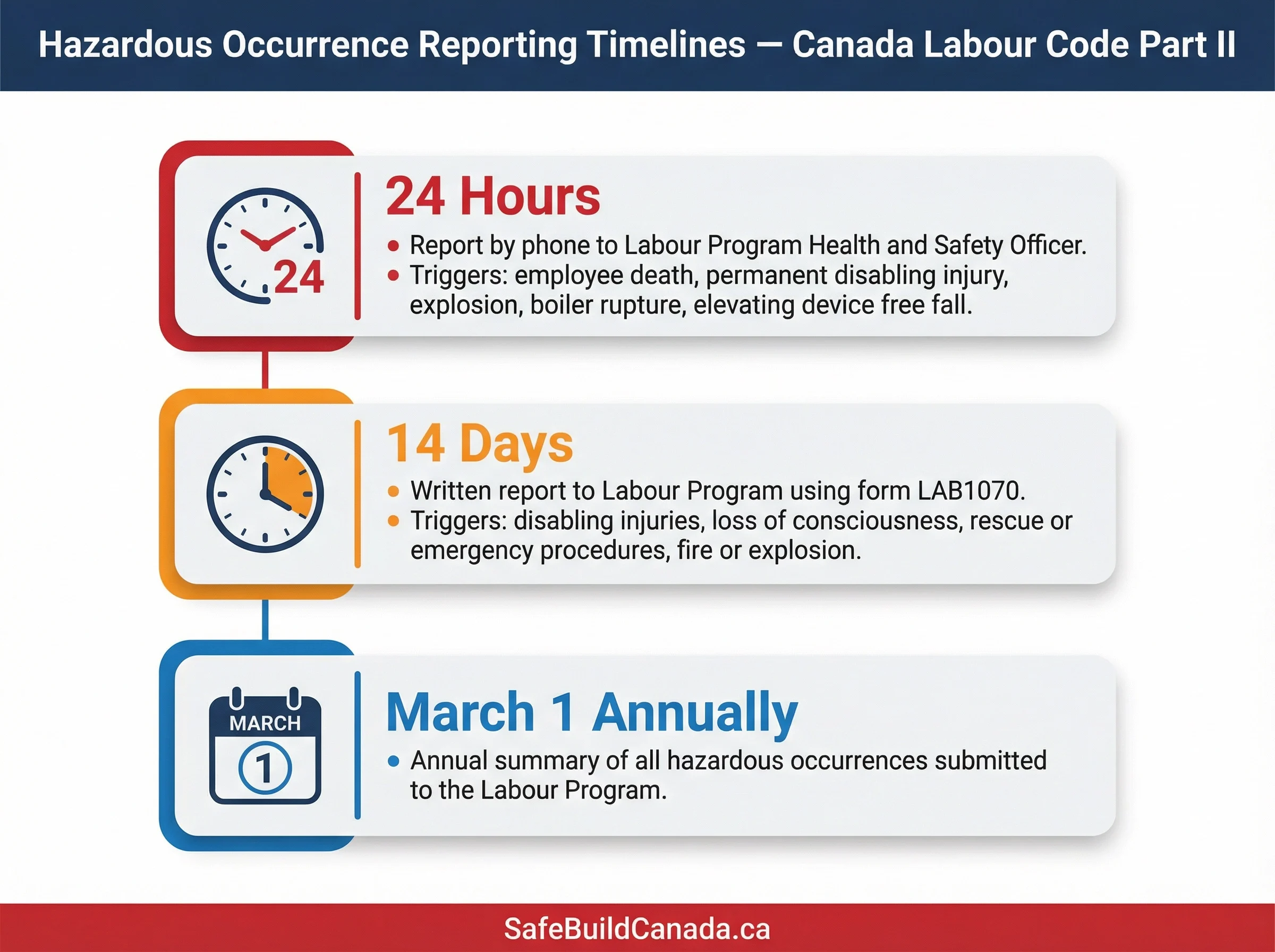
The 24-hour report is the most urgent. If an occurrence results in the death of an employee, a permanent disabling injury, temporary disabling injuries to two or more employees from the same occurrence, a permanent impairment of a body function, an explosion, or damage to a boiler or pressure vessel that results in fire or rupture, the employer must report by telephone to a Labour Program health and safety officer within 24 hours of becoming aware of the occurrence. The accident scene must not be disturbed without authorization from the officer.
The 14-day written report covers a broader range of occurrences: disabling injuries (temporary or permanent), loss of consciousness from electric shock or toxic atmosphere, and incidents requiring rescue or emergency procedures. This report must be submitted using the Hazardous Occurrence Investigation Report form (LAB1070) or an equivalent document containing all required information.
Annual reports are due by March 1 each year. Employers must submit a summary of all hazardous occurrences from the previous calendar year to the Labour Program.
Missing these deadlines is not a paperwork issue. Failure to report is a violation of the Canada Labour Code, and it can trigger administrative monetary penalties under the Administrative Monetary Penalties (Canada Labour Code) Regulations (SOR/2020-260), as well as prosecution under section 148 of the Code. On conviction on indictment, penalties reach $1,000,000 or two years imprisonment, or both.
How Part II interacts with provincial OHS law
One of the practical complications for federally regulated construction employers is that Part II does not operate in a vacuum. Workers on a federally regulated project may be subject to federal OHS law for their primary employment relationship, but the physical site they are working on may also be subject to provincial building codes, municipal permits, and provincial environmental regulations.
The rule is that Part II governs OHS obligations for federally regulated workers, regardless of which province the work is performed in. Provincial OHS legislation does not apply to federally regulated workplaces. This means that if you are a federally regulated employer, you cannot rely on Ontario's OHSA or BC's OHS Regulation as your compliance framework. You need to understand Part II and the COHSR.
For employers who work across both federal and provincial jurisdictions, this creates a real administrative challenge. You may have crews on provincial construction sites governed by provincial OHS law and crews on federally regulated projects governed by Part II, sometimes on the same week. The Canadian construction OHS regulation updates for 2025 and 2026 covers recent changes across both federal and provincial frameworks that affect how employers manage this complexity.
What enforcement looks like under Part II
Enforcement of Part II is carried out by the Labour Program, which is part of Employment and Social Development Canada (ESDC). Labour Program health and safety officers have broad powers: they can enter any federally regulated workplace at any reasonable time, inspect the workplace, examine records, take samples, and issue directions requiring employers to correct contraventions.
Directions can require immediate action or set a compliance deadline. If an employer fails to comply with a direction, the officer can escalate to prosecution. The administrative monetary penalties system introduced in 2021 gives the Labour Program an additional enforcement tool: penalties can be issued without prosecution, and they are designed to be proportionate to the severity and history of the violation.
Understanding what happens when an OHS inspector shows up on your construction site applies to federal inspections as much as provincial ones. The preparation principles are the same: know your documentation, know your committee structure, and know your procedures.
Building a compliant federal OHS program
A compliant federal OHS program under Part II is not structurally different from a good provincial OHS program. The elements are the same: hazard identification, safe work procedures, training, inspections, incident investigation, and emergency response. What differs is the specific regulatory framework you are working within and the reporting obligations attached to it.
The starting point is confirming your jurisdiction. If you are not certain whether Part II applies to your work, get a clear answer before your next project starts. The consequences of getting it wrong, either by applying provincial standards to a federally regulated project or by assuming federal standards apply when they do not, are significant.
Once jurisdiction is confirmed, the practical steps are: establish your WPHSC or health and safety representative structure based on your employee count, implement the hazardous occurrence reporting procedures with clear internal timelines that leave room before the statutory deadlines, train supervisors on the right to refuse procedure, and document everything.
The broader OHS regulatory landscape for construction employers in Canada is covered in the OHS regulations in Canada guide, which addresses both federal and provincial frameworks and how they interact across different project types.
Part II is not the most complex OHS statute in Canada, but it is the one that federally regulated employers most often underestimate. The penalties for getting it wrong are real, the enforcement is active, and the workers covered by it have the same rights as any other Canadian worker. Treat it accordingly.
Sources
Government of Canada, Employment and Social Development Canada. Summary of Part II of the Canada Labour Code. ESDC, updated 2024.
Government of Canada, Employment and Social Development Canada. Hazardous Occurrence Investigation Recording and Reporting. ESDC, updated December 30, 2025.
Government of Canada. List of federally regulated industries and workplaces. Canada.ca, updated January 30, 2026.
Government of Canada, Department of Justice. Canada Labour Code, RSC 1985, c. L-2, Part II: Occupational Health and Safety, sections 122 to 148. Justice Laws Website, current to December 12, 2025.
Government of Canada, Department of Justice. Canada Occupational Health and Safety Regulations, SOR/86-304. Justice Laws Website, current to 2025.